
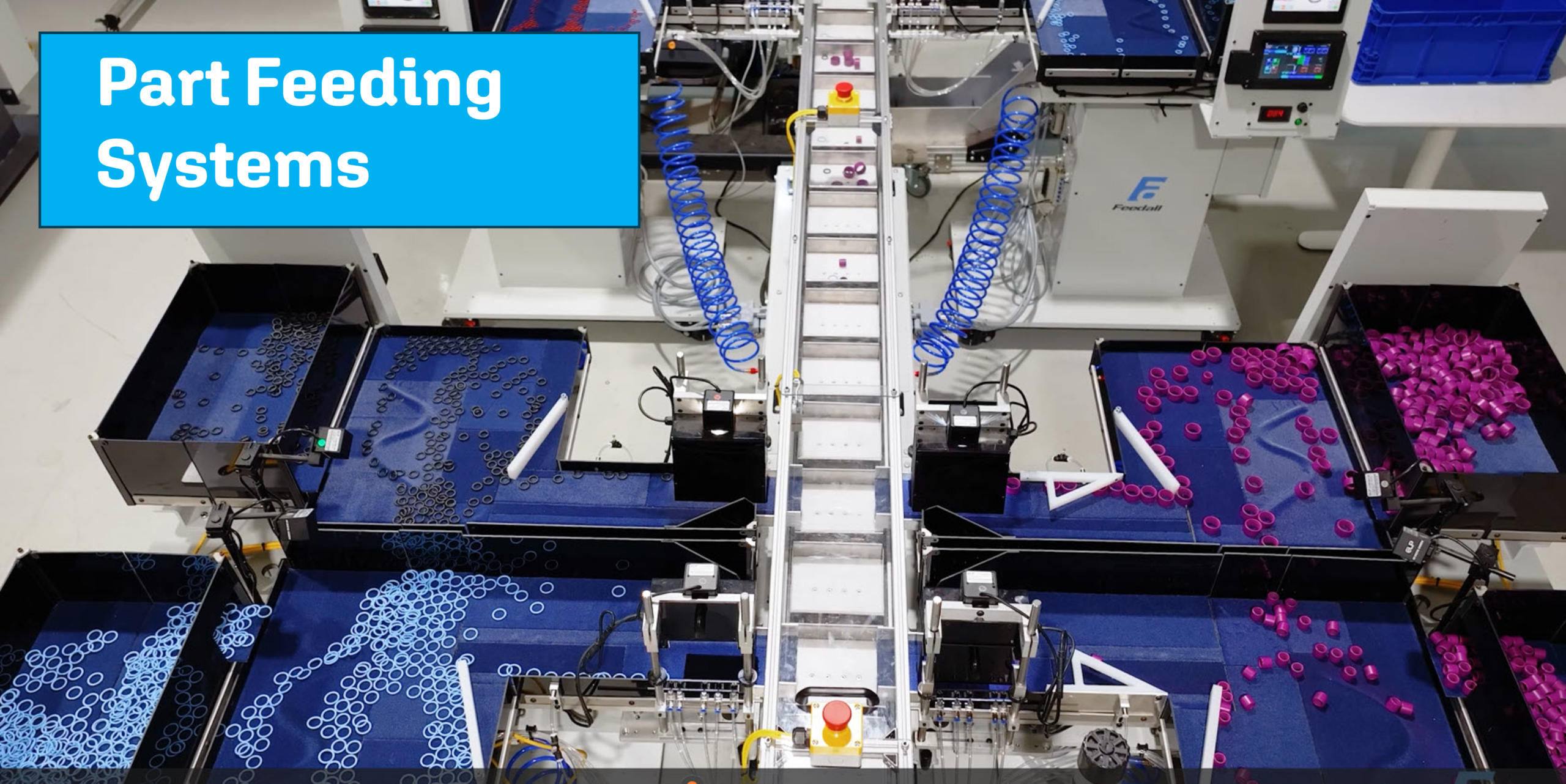
Industrial Part Feeding Systems: Types, Applications, and Automation Strategy
Industrial automation is only as reliable as the way parts are delivered to the process.
Even the most advanced robotics, vision systems, and assembly equipment cannot perform at their best if parts arrive inconsistently — or if operators must manually load components to keep production moving.
That is why part feeding systems are one of the most important foundations of modern manufacturing. Whether you’re running a high-speed dedicated assembly line or building a flexible robotic cell, the right feeding strategy directly impacts:
Throughput
Uptime
Labor costs
Changeover time
Long-term ROI
In this guide, we’ll break down what part feeding systems are, the most common feeder types, and how to determine the best solution for your automation environment.
What Are Part Feeding Systems?
Part feeding systems are automation solutions designed to take parts from bulk supply and deliver them in a consistent, repeatable manner to downstream equipment.
A well-designed feeding system typically performs three critical functions:
Supplies parts continuously (preventing machine starvation)
Separates parts from bulk supply (reducing tangling and jams)
Presents parts in a usable orientation (for assembly, inspection, or robotic picking)
Without stable feeding, even the most advanced automation system becomes unreliable.
Why Part Feeding Systems Matter in Automation
In real-world production environments, feeding is often where automation projects succeed or fail.
1. Throughput
If parts are not delivered fast enough, robots and machines sit idle. Feeding directly determines production speed.
2. Uptime
Feeding-related jams and misfeeds are among the most common causes of downtime in automated systems.
3. Labor Reduction
Manual loading introduces variability and ongoing labor cost. Automated part feeding systems eliminate this dependency.
4. Quality Control
Inconsistent part orientation increases the risk of mispicks, improper assembly, and downstream defects.
A properly engineered part feeding system stabilizes the entire automation cell.
The Most Common Types of Industrial Part Feeding Systems
There is no single “best” feeder — only the right feeder for your application.
1. Vibratory Bowl Feeders
Vibratory bowl feeders use controlled vibration to move parts along a spiral track. Tooling along the track orients parts into a repeatable position before discharge.
Best for:
High-volume production
Single part type
Stable, long production runs
Small to medium components
Strengths:
High feed rates
Proven reliability
Excellent orientation precision
Limitations:
Custom tooling required
Slower changeovers
Not ideal for high-mix production
2. Flexible Feeding Systems
Flexible feeding systems (also called flex feeding) use vibration, vision systems, and robotics to identify and pick parts without hard tooling.
Instead of mechanically orienting parts, they:
Spread parts across a surface
Use cameras to locate pickable components
Guide a robot for pick-and-place
Best for:
Multiple part types
High-mix manufacturing
Robotic automation cells
Frequent changeovers
Flexible feeding has become the preferred strategy for manufacturers seeking long-term adaptability.
3. Centrifugal Feeders
Centrifugal feeders use spinning discs to orient parts at high speed with reduced noise.
Best for:
Lightweight components
High-speed orientation
Noise-sensitive environments
4. Vibratory Conveyors and Linear Feeders
These systems transfer parts between stages and provide buffering.
They are commonly used:
Between bowl feeders and assembly stations
To maintain spacing
For controlled part movement
5. Bulk Feeders and Hoppers
Bulk feeding systems supply large volumes of parts to orientation equipment.
They:
Reduce manual refilling
Maintain consistent supply
Improve line stability
Bulk feeders are often paired with bowl feeders or flexible feeding systems.
How to Choose the Right Part Feeding System
Selecting the right system requires evaluating both part characteristics and production strategy.
Part Geometry
Does the part nest or tangle?
Is orientation critical?
Is the surface reflective or delicate?
Is it symmetrical?
Production Volume
High-volume, single SKU → Bowl feeding often wins.
Multi-SKU, changing parts → Flexible feeding is usually better.
Changeover Frequency
Frequent changeovers make hard tooling less attractive.
Robotics Integration
If robotics are central to the automation cell, flexible feeding systems often integrate more seamlessly.
Long-Term Scalability
The lowest upfront cost is not always the best long-term investment. Consider future product evolution.
Modern Strategy: Hybrid Feeding Systems
Many manufacturers now combine technologies:
Bowl feeders for dedicated, high-volume parts
Flexible feeders for evolving SKUs
Bulk feeders for stable supply
This hybrid strategy balances throughput and flexibility.
Common Applications of Part Feeding Systems
Part feeding systems are used across nearly every industrial sector:
Automotive manufacturing
Electronics assembly
Medical device production
Consumer products
Packaging systems
Aerospace components
Any operation requiring consistent, repeatable part presentation can benefit from optimized feeding.
Frequently Asked Questions
What is the purpose of a part feeding system?
A part feeding system supplies, separates, and presents parts consistently so automated equipment can operate efficiently without manual loading.
What is the difference between a bowl feeder and a flexible feeder?
A bowl feeder uses mechanical tooling to orient one part type at high speed.
A flexible feeder uses vibration and vision to handle multiple part types with faster changeovers.
Can part feeding systems integrate with robotics?
Yes. Modern part feeding systems are often designed specifically for robotic automation, especially flexible feeding solutions.
Final Thoughts: Automation Starts with Feeding
Industrial automation does not start with robots — it starts with feeding.
A properly engineered part feeding system improves:
Throughput
Uptime
Labor efficiency
Product quality
Long-term ROI
Whether you require vibratory feeding, flexible feeding, or a hybrid solution, designing the right feeding strategy is the foundation of reliable automation.
If you’re planning an automation project, Feedall can help you determine the optimal feeding system for your application and production goals.