
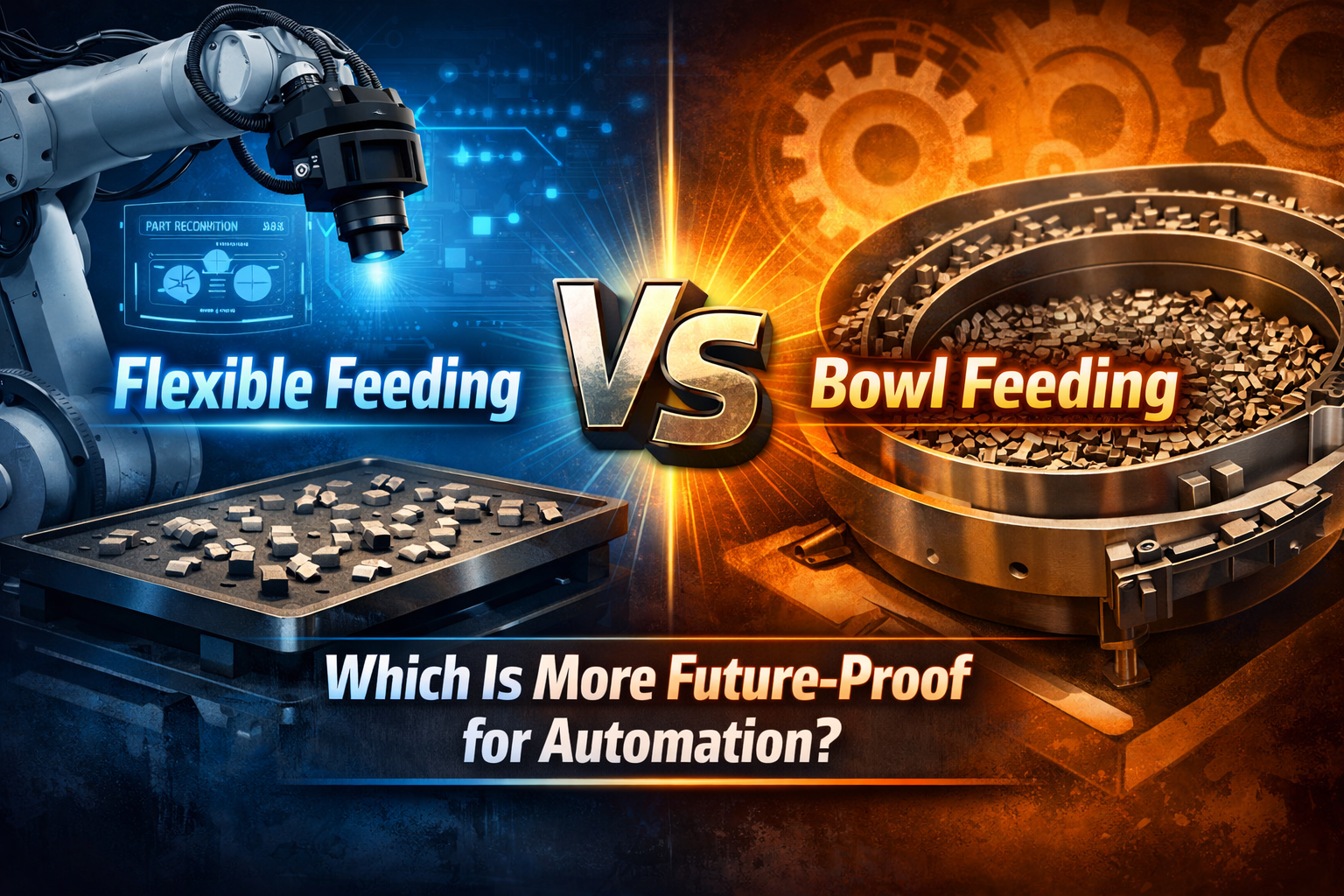
Flexible Feeding vs Bowl Feeding: Which Is More Future-Proof for Automation?
Introduction
When evaluating automation strategies, one of the most critical decisions manufacturers face is choosing between flexible feeding vs bowl feeding. This choice directly impacts system adaptability, production efficiency, long-term costs, and how well your operation can evolve with changing product demands.
As industries shift toward high-mix, low-volume production and increased robotics integration, feeding technology is no longer just a supporting component—it’s a strategic investment. The right feeding solution can determine whether your automation system thrives over time or becomes a bottleneck that requires costly rework.
In this guide, we’ll break down how flexible feeding and bowl feeding compare, where each excels, and which option is better positioned for the future of manufacturing.
What Is Flexible Feeding?
Flexible feeding systems are designed for adaptability. They typically consist of three main components:
- A vibratory surface or platform that presents parts randomly
- A vision system that identifies part orientation and location
- A robot that picks and places parts based on visual data
Unlike traditional systems, flexible feeders don’t rely on custom mechanical tooling to orient parts. Instead, they use software and vision-guided robotics to handle a wide variety of components on the same platform.
Key Benefits of Flexible Feeding
1. Rapid Changeovers
Flexible feeding systems can switch between parts with minimal downtime. In many cases, changeovers are as simple as loading a new recipe in the software.
2. Reduced Tooling Costs
Because they don’t require dedicated tooling for each part, flexible feeders eliminate the need for costly custom bowls, tracks, and mechanical adjustments.
3. Seamless Robotics Integration
Flexible feeding is inherently designed to work with robotic systems, making it ideal for modern automation environments.
4. Future Scalability
As product lines evolve, flexible feeders can adapt without requiring major system redesigns.
What Is Bowl Feeding?
Vibratory bowl feeders have been a staple in manufacturing for decades. They use vibration and precisely engineered tooling to orient and feed parts in a consistent, repeatable manner.
Each bowl feeder is typically designed for a single part or a very narrow range of similar parts. The tooling ensures that components are correctly oriented before they exit the system.
Key Benefits of Bowl Feeding
1. High-Speed Output
Bowl feeders excel in high-volume production environments where speed and consistency are critical.
2. Proven Reliability
With decades of use across industries, bowl feeding is a well-understood and dependable technology.
3. Precision Orientation
Custom tooling ensures parts are delivered in the exact orientation required for downstream processes.
Flexible Feeding vs Bowl Feeding: Key Differences
1. Changeovers and Flexibility
One of the most significant differences between flexible feeding and bowl feeding is how each system handles changeovers.
- Flexible Feeding:
Designed for quick transitions, flexible feeders can handle multiple part types with minimal adjustments. Changeovers are often software-driven, reducing downtime dramatically. - Bowl Feeding:
Changeovers typically require mechanical retooling, including swapping bowls, tracks, and tooling components. This process can be time-consuming and labor-intensive.
Bottom Line:
If your production involves frequent product changes or short runs, flexible feeding offers a clear advantage.
2. Robotics Integration
Automation today is increasingly centered around robotics, and feeding systems must align with this shift.
- Flexible Feeding:
Built specifically for robotic integration, these systems rely on vision-guided robots to pick parts directly from the feeder surface. - Bowl Feeding:
While bowl feeders can be integrated with robots, they are traditionally used in dedicated, linear automation systems.
Bottom Line:
Flexible feeding is better suited for robotic work cells and Industry 4.0 environments.
3. Long-Term ROI
Initial cost is only part of the equation. Long-term return on investment depends on adaptability, maintenance, and scalability.
- Flexible Feeding:
Higher upfront investment, but lower long-term costs due to reduced tooling, faster changeovers, and the ability to handle new products without additional hardware. - Bowl Feeding:
Lower initial cost for single-part applications, but higher cumulative costs if multiple parts or frequent changes are required.
Bottom Line:
Flexible feeding typically delivers better ROI in dynamic production environments.
4. Production Volume and Stability
Production requirements play a major role in determining the best solution.
- Flexible Feeding:
Ideal for low-to-medium volume production with high product variability. - Bowl Feeding:
Best suited for high-volume, stable production runs where the part design rarely changes.
Bottom Line:
Bowl feeding still dominates in highly stable, high-output environments.
5. Maintenance and Complexity
- Flexible Feeding:
Requires expertise in vision systems and robotics but eliminates many mechanical wear points. - Bowl Feeding:
Mechanical systems require ongoing maintenance, especially for tooling that experiences wear over time.
Bottom Line:
Flexible systems shift complexity toward software, while bowl feeders rely more on mechanical upkeep.
When Bowl Feeding Still Makes Sense
Despite the growing popularity of flexible feeding, bowl feeders remain the best choice in certain scenarios.
Ideal Use Cases for Bowl Feeding
- High-volume production with minimal variation
- Single-part applications with long product lifecycles
- Environments where maximum speed is the top priority
- Situations where simplicity and proven reliability outweigh flexibility
In these cases, the efficiency and speed of a well-designed bowl feeder can outperform more adaptable systems.
When Flexible Feeding Is the Better Choice
Flexible feeding shines in modern manufacturing environments where change is constant.
Ideal Use Cases for Flexible Feeding
- High-mix, low-volume production
- Frequent product changeovers
- Robotic automation cells
- Companies planning for future product expansion
- Operations looking to reduce tooling costs and downtime
As product lifecycles shorten and customization increases, these scenarios are becoming more common.
The Future of Automation: Why Flexibility Matters
Manufacturing is undergoing a fundamental shift. Traditional mass production is giving way to more agile, responsive systems that can adapt quickly to market demands.
Several trends are driving this change:
- Increased product customization
- Shorter product lifecycles
- Labor shortages driving automation adoption
- Greater reliance on robotics and vision systems
In this environment, flexibility is no longer a luxury—it’s a necessity.
Flexible feeding systems align directly with these trends by enabling manufacturers to:
- Respond quickly to new product requirements
- Minimize downtime during transitions
- Scale operations without major reinvestment
- Integrate seamlessly with advanced automation technologies
Conclusion: Which Is More Future-Proof?
When comparing flexible feeding vs bowl feeding, the answer ultimately depends on your production needs.
- If your operation is high-volume, stable, and unlikely to change, bowl feeding remains a powerful and efficient solution.
- If your operation requires adaptability, fast changeovers, and robotics integration, flexible feeding is the more future-proof choice.
For most modern manufacturers, the trend is clear: flexibility, scalability, and automation readiness are becoming the defining factors of long-term success.
Choosing the right feeding system isn’t just about solving today’s challenges—it’s about preparing for what comes next. Contact Feedall for more information.