
Choosing the Right Feeder Surface: An Engineer’s Guide
When engineers troubleshoot a vibratory feeder or flex feeder, they often focus on the obvious variables:
- Vibration amplitude
- Frequency
- Track geometry
- Tooling
- Vision systems
- Robot programming
Yet one of the most overlooked factors is also one of the most influential:
The feeder surface itself.
The wrong surface can reduce feed rates, increase noise, damage parts, and shorten equipment life. The right surface can dramatically improve conveying consistency, part orientation, and overall system performance.
After nearly 80 years of designing part feeding systems, we’ve learned an important lesson:
There is no single “best” feeder surface. There is only the best surface for your specific application.
Why Feeder Surfaces Matter
Every feeder surface changes the interaction between the part and the feeder.
That interaction affects:
- Friction
- Sliding behavior
- Rolling tendencies
- Part stability
- Noise generation
- Surface protection
- Wear life
Selecting the wrong material often creates problems that engineers mistakenly attribute to bowl tooling or vibration settings.
Brush Surfaces
Best for:
- Delicate parts
- Cosmetic finishes
- Fast conveying
- Noise reduction
- Precision components
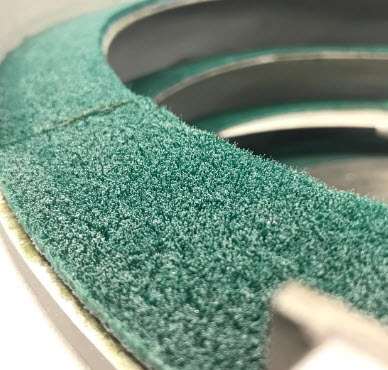
For decades, angled brush materials such as 3M Brushlon® became the industry standard because they reduced metal-to-metal contact while allowing vibration to gently move parts along the track.
Today, the Mink Slide-Brush® continues that concept with modern materials and manufacturing. Its angled nylon fibers help guide parts through both linear and spiral tracks while reducing noise and minimizing scratches. According to Mink, the Slide-Brush® also offers improved conveying performance, high flexibility, and can reduce noise levels by up to 40%.
Advantages
✔ Excellent for finished parts
✔ Very quiet operation
✔ Gentle handling
✔ Reduced scratching
✔ High conveying efficiency
Limitations
- Higher initial cost than plastic liners
- Not ideal for extremely abrasive environments
Heavy-Duty Slide-Brush®
Best for:
- Large components
- Heavy steel parts
- Complex geometries
Heavy parts require more support than traditional brush materials can provide.
For these applications, Feedall offers a Heavy-Duty Slide-Brush® with larger fibers that better support heavier payloads while maintaining controlled movement. The MSB1330-K1 uses thicker 0.30 mm bristles with a 9.5 mm fiber length, making it well suited for heavier or more demanding applications.
Typical applications include:
- Forgings
- Castings
- Large stampings
- Automotive components
Food-Grade Brush Surfaces
Best for:
- Medical devices
- Pharmaceutical components
- Food processing
Food-grade applications require materials that satisfy strict cleanliness and traceability requirements.
The Food Grade Slide-Brush® uses food-certified PA6 bristles and is easily identifiable by its blue color, making it suitable for regulated manufacturing environments.
UHMW Surfaces
Best for:
- Cylindrical parts
- High wear areas
- Rolling control
Ultra-high molecular weight polyethylene (UHMW) provides:
- Extremely low friction
- Excellent wear resistance
- Long service life
Feedall often combines UHMW with anti-roll geometries to prevent pins, shafts, and bushings from continuously rotating during conveying. The Feedall Flex brochure identifies Anti-Roll UHMW as one of its modular surface options.
Thermoplastic Surfaces
Best for:
- Abrasive materials
- High-volume production
- Applications where wear resistance is the priority
Some applications simply destroy brush materials.
Sharp-edged stampings, powdered metal parts, and rough castings may require a harder thermoplastic surface capable of withstanding continuous abrasion.
Although these surfaces typically generate more noise than brush materials, they often deliver the lowest maintenance cost over long production runs.
Soft Brush Surfaces
Best for:
- Plastic components
- Cosmetic products
- Delicate assemblies
Some products cannot tolerate hard contact.
Soft Brush surfaces provide gentle movement while minimizing cosmetic damage, making them ideal for highly finished or fragile components. Feedall includes Soft Brush as one of its modular surface kit options for gentle part movement.
Why Feedall Uses Modular Surface Kits
One of the biggest limitations of traditional vibratory bowl feeders is that the conveying surface is typically permanent.
If your product changes…
…your surface often should too.
That’s why Feedall developed interchangeable Modular Surface Kits for its Flex Feeders.
Instead of replacing an entire feeder, customers can install a different surface optimized for:
- Heavy parts
- Delicate parts
- Cylindrical parts
- Food-grade applications
- Abrasive materials
This gives manufacturers far greater flexibility as production requirements evolve. The Feedall Flex platform offers modular kits including Slide-Brush®, Heavy Duty Slide-Brush®, Food Grade Slide-Brush®, Thermoplastic, Soft Brush, and Anti-Roll surfaces.
Five Questions to Ask Before Choosing a Feeder Surface
Before selecting a surface, ask:
1. How heavy are the parts?
Weight affects how much support the conveying surface must provide.
2. Can the part be scratched?
Finished, coated, or polished parts typically benefit from brush surfaces.
3. Will the part roll?
Pins, shafts, and bushings often require anti-roll surfaces.
4. Is abrasion a concern?
Sharp edges may favor thermoplastic over brush materials.
5. Is flexibility important?
If your product mix changes frequently, modular surface kits can significantly reduce changeover time.
Feedall’s Engineering Philosophy
At Feedall, we don’t believe in selling a single feeder surface for every application.
We believe in matching the conveying technology to the part.
That philosophy is why we offer multiple modular surface options and why we partnered with Mink Bürsten to bring advanced Slide-Brush® technology exclusively to North America. Beyond supplying material, our goal is to help manufacturers optimize throughput, reduce maintenance, and improve overall feeding performance through the right engineering solution.
Continue Learning
- The Best Replacement for 3M Brushlon® 321B: Meet Feedall’s New Slide-Brush® Solution
- The Legacy of Brushlon®: How Feedall Is Reviving One of Manufacturing’s Greatest Part Feeding Innovations
- How to Choose the Right Flex Feeder
- Why Flexible Parts Feeding Is Replacing Vibratory Bowl Feeders
- What Is a Vibratory Bowl Feeder?
- When Should You Choose a Flex Feeder Instead of a Bowl Feeder?
- How Feedall Engineers Complete Robotic Feeding Systems