
Benefits of Feedall’s Random Loading Bar Feeder
Feedall Automation | November 3, 2026 | Part Feeding
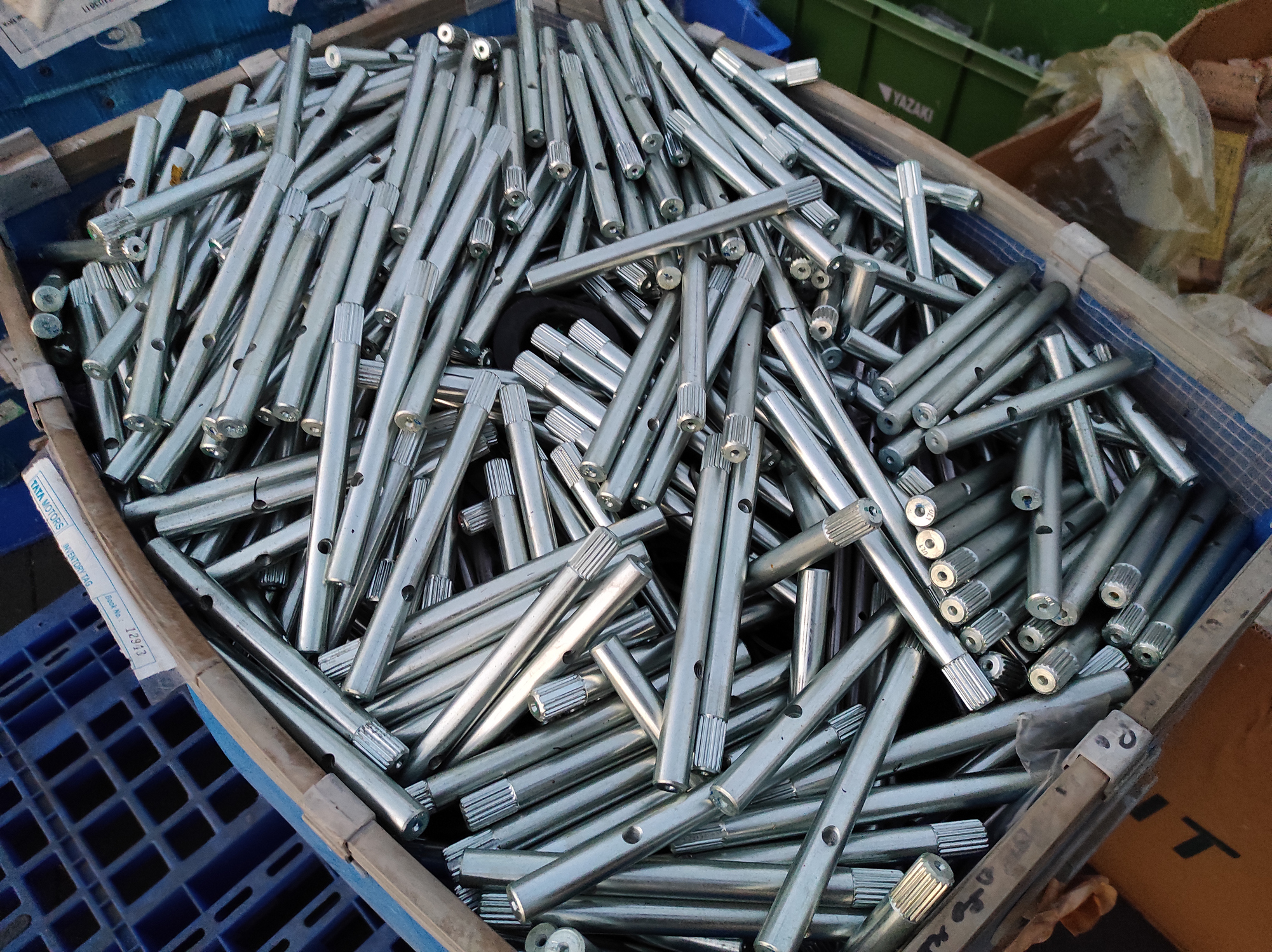
A bar feeder is only as productive as the way it is loaded. If an operator has to stack, align and orient every bar by hand, the feeder keeps a machine busy but keeps a person busy too. A random loading bar feeder changes that equation: bars, tubes and cut-to-length parts are dumped into a hopper in any order, and the feeder does the work of singulating and presenting them to the next operation.
Feedall builds this capability into its floor-loaded Retriever bar feeders. This article explains how random loading works, the benefits it delivers, and how to decide whether it fits your application.
What Is a Random Loading Bar Feeder?
A random loading bar feeder is a floor- or hopper-loaded system. Instead of requiring parts to be pre-stacked in a magazine, it lets you load parts loosely into a hopper. A vertical elevator lifts the parts on individual pads and discharges them one at a time, rolling into a magazine. From there they move to a cross conveyor, pusher, walking beam or directly into your machine or process. Because parts are elevated individually, there is zero circulation of parts in the hopper, which keeps noise low and helps protect part finish.
Feedall’s floor-loaded Retriever 2212, 2224 and 2236 bar feeders handle tubes, cut-to-length bars and machined parts up to 12, 24 and 36 inches long respectively, with diameter ranges within a 2 to 1 ratio. For longer parts, the long bar feeder line handles parts up to 50 inches.
Key Benefits of a Random Loading Bar Feeder
- Less hand-loading and staging. Operators can load parts in bulk and in any order, by hand, load cart, drop-bottom container or bundle loader, instead of aligning every bar.
- Longer run times between refills. A large hopper holds a meaningful supply of parts, so machines such as centerless grinders, thread rollers and polishing machines are not waiting on an operator.
- Flexible loading options. Hand stacked/loaded, load cart, drop-bottom container and bundle loader, and with hopper modifications parts can be fed from a previous operation by conveyor.
- Gentle, quiet operation. Individual pads lift each part rather than churning the whole load.
- Built for the application. Bolt-on cleat pads are machined for each application’s part range, and a variable speed elevator drive lets you tune the feed rate. Options include a telescoping ramp to a centerless grinder, cross-feed conveyors, part transfers, qualifiers and pushers.
- Proven manufacturer support. Family-owned, U.S.-based manufacturer since 1946.
Random Loading vs. Magazine-Loaded Bar Feeders
| Factor | Floor / random loaded (Retriever 2212-2236, 2250) | Magazine loaded (Retriever 1700, 1750, 1775) |
| Loading method | Parts loaded into a hopper in any order | Parts hand stacked or bundle loaded into a magazine |
| Operator effort | Lowest; no alignment of parts | Low to moderate; parts are staged in the magazine |
| Part length | 12 to 36 in (2212-2236); up to 50 in (2250) | 4 to 28 in (1700); 0.5 to 12 in (1750); beyond 28 in (1775) |
| Best for | Tubes, cut-to-length bars, machined parts with a 2 to 1 diameter range | Small to long bars and tubes where precise magazine staging suits the process |
Where a Random Loading Bar Feeder Fits Best
Look at a random loading feeder when you run repeat volumes of cut-to-length bars, tubes or machined parts into a grinder, roller, polisher or other secondary operation, and when hand-loading is a labor cost or a bottleneck. If your parts are very short, a magazine-loaded feeder such as the Retriever 1750 small bar feeder may be a better fit. A feeding trial with your real parts is the best way to confirm.
See how bar feeding compares with other options in our part feeding guides, explore vibratory feeders, or learn why flexible parts feeding is growing in high-mix production.
Frequently Asked Questions
What is a random loading bar feeder?
A floor- or hopper-loaded bar feeder that accepts bars, tubes and cut-to-length parts loaded in any order. An elevator lifts parts on individual pads and discharges them one at a time.
What sizes of bar feeder does Feedall offer?
The Retriever line covers parts from 0.5 inch to 50 inches long, in magazine-loaded and floor-loaded models.
How do I load a Feedall bar feeder?
Hand stacked/loaded, load cart, drop-bottom container or bundle loader, depending on the model, plus conveyor feed from a previous operation with hopper modifications.
Can a bar feeder feed a centerless grinder?
Yes. Options such as a telescoping ramp from the magazine to the conveyor support centerless grinder applications.
How do I know which bar feeder fits my parts?
Send your part details to Feedall; our team will recommend a model and can evaluate your parts first.
Get the Right Bar Feeder for Your Application
Feedall Automation has helped manufacturers raise production rates since 1946. If hand-loading is slowing your line, a random loading bar feeder may be the simplest upgrade you can make. Request a quote or contact our team with your parts and requirements, or call 1-800-942-8101.