
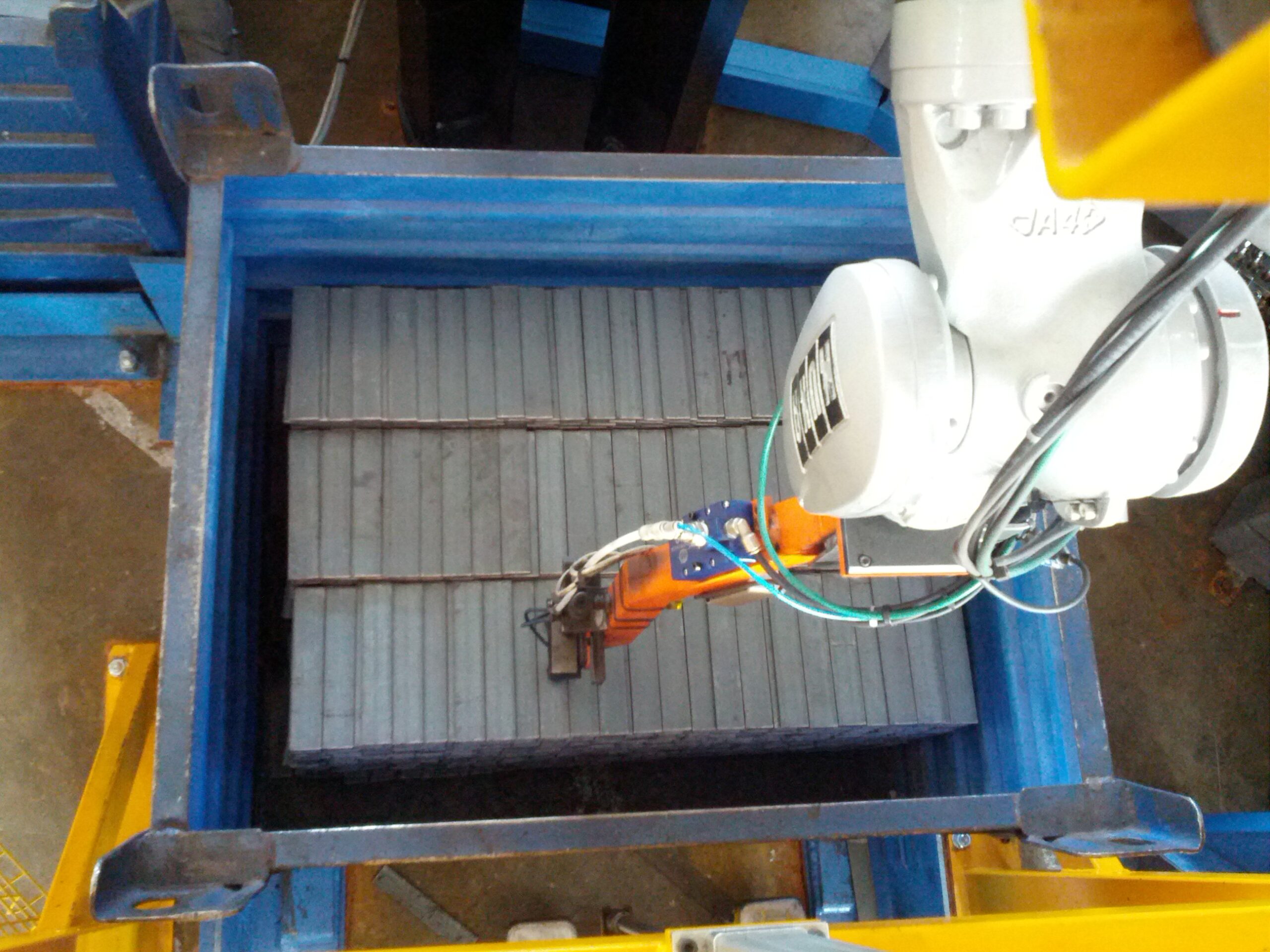
Robotic bin picking looks like the answer to almost every messy-parts problem on a shop floor: dump a container of components, let a robot with a camera sort it out, and skip the fixturing altogether. In practice, robotic bin picking is a powerful tool for a specific set of applications, and a costly overreach for others. Knowing which situation you are in before you invest is what separates a bin picking cell that pays for itself in a year from one that never gets past a partial pick rate on the shop floor.
This guide breaks down what robotic bin picking actually is, the technology doing the work, and, more importantly, the conditions under which it is the right call versus when a simpler feeding solution will get you to full automation faster and cheaper.
What Is Robotic Bin Picking?
Robotic bin picking is the use of a robot, a 3D vision system, and picking software to locate, grasp, and remove individual parts from a bin picking or container without manual pre-sorting. It falls into two broad categories.
Structured bin picking is where parts are loosely organized — separated by layer, partially nested, or placed with some consistent orientation — which narrows the amount of guesswork the vision system has to do. Random bin picking is where parts are dumped in bulk with no order at all. This is the harder problem, since parts overlap, tangle, reflect light unpredictably, and present in an effectively infinite number of orientations.
The vision system scans the bin, a picking algorithm matches what it sees against a known part model, and the robot’s path planner calculates a collision-free route to grasp and remove the part, then does it again, bin after bin, shift after shift.
The Technology Behind It
A working bin picking cell is not just a robot with a camera bolted on. It is a stack of coordinated systems, including 3D vision hardware that scans the bin and generates a depth map of what is inside, picking software that matches that scan against known part geometry and calculates a viable grasp point and trajectory, path planning and collision detection so the robot arm does not strike the bin walls or other parts on its way out, and end-of-arm tooling — vacuum, parallel, or soft grippers — matched to the part’s material, weight, and surface.
Feedall’s own bin picking platform pairs the Mizar 3D camera with Moonflower picking software to handle exactly this stack. Moonflower’s path planner includes built-in collision detection and simulation, and its camera placement is flexible — mounted between bin locations or directly on the robot arm — which matters more than it sounds like once you are trying to fit a cell into an existing footprint.
When Robotic Bin Picking Makes Sense
Robotic bin picking earns its cost when most of the following are true for your application.
High part volume with no practical way to pre-sort. If you are running enough volume that a person or a structured feeder cannot keep pace, and the parts arrive from suppliers in bulk totes rather than trays, bin picking removes a manual step that would otherwise bottleneck the line.
Cycle time has room to breathe. Vision-guided picking typically takes longer per part than a mechanical feeder. If your process can absorb a longer cycle time without starving downstream operations, bin picking fits. If you need very fast, sub-two-second cycle times, it usually will not keep up.
Parts are matte, not mirror-finished. Reflective and highly polished metal parts scatter light in ways that confuse most 3D vision systems. Matte or lightly oxidized surfaces scan far more reliably.
You can tolerate a partial easy-pick rate. Even well-tuned bin picking systems typically retrieve the majority of parts quickly, then slow down, or need a human backstop, for the remainder that end up in corners, deeply tangled, or stacked against the bin wall — a pattern industry evaluators such as HowToRobot have documented in their own reviews of bin picking deployments. If your process can route those stragglers aside without stopping the line, bin picking works. If every part must come out on the first attempt, budget for that gap.
Parts change frequently or come from multiple SKUs. Bin picking software can be reprogrammed for a new part model faster than a mechanical feeder bowl or track can be retooled, which matters in high-mix environments.
When It Might Not Be the Right Fit
Bin picking is not automatically the answer just because parts arrive unordered. A few situations where a different Feedall solution will outperform it follow below.
Your parts are small, uniform, and feed at high speed. For screws, washers, pins, and other small hardware run at speed, a vibratory bowl feeder or flex feeder will out-cycle a vision-guided robot every time, at a fraction of the per-part cost.
Your supplier can deliver parts pre-organized. If totes, trays, or layer-separated packaging are available at a reasonable cost, it is frequently cheaper and faster to pay for structured delivery than to solve random bin picking in-house.
Parts are highly entangled or heavily reflective. Wire forms, springs, and polished stampings remain some of the hardest categories for any vision system on the market today, Feedall’s included. In these cases, a mechanical orienting or vibratory solution paired with a charging conveyor to meter parts is often the more reliable path.
You need a guaranteed complete pick rate with zero exceptions. No current vision-guided bin picking system, regardless of vendor, clears a bin without occasional human or secondary intervention. If your process genuinely cannot tolerate that, structured feeding is the safer investment.
Bin Picking vs. Flex Feeding vs. Vibratory Bowl Feeding
| Robotic Bin Picking | Flex Feeding | Vibratory Bowl Feeding | |
| Best for | Bulk, unordered parts; high-mix production | Frequent part changeovers; moderate volume | High-volume, single-part runs |
| Typical cycle time | Slower (vision + path planning) | Fast | Fastest |
| Part variety | Handles multiple SKUs with software changes | Very high; reprogrammed, not retooled | Low; one bowl tooled per part |
| Surface tolerance | Struggles with reflective/entangled parts | Moderate | Moderate to high |
| Changeover time | Software update | Minutes | Hours (new bowl tooling) |
| Typical pick/feed rate | ~80-85% “easy,” rest need assist | Near 100% | Near 100% |
Is Robotic Bin Picking Right for Your Application? A Quick Checklist
☐ Parts arrive unordered, in bulk totes, with no cost-effective way to pre-sort
☐ Cycle time requirement is on the slower side, not sub-two-second
☐ Part surfaces are matte or lightly finished, not mirror-polished
☐ You can route occasional “hard pick” exceptions aside without stopping the line
☐ You run multiple part numbers through the same cell and need software-level changeover
☐ You’ve evaluated structured delivery from your supplier and it isn’t cost-effective
Checking most of these boxes is a strong signal robotic bin picking belongs in your automation plan. Checking few of them, and a flex feeder or vibratory bowl feeder is likely to get you to full automation faster and at lower cost.
How Feedall Approaches Bin Picking
Feedall has spent more than 75 years building part feeding automation, and that engineering discipline carries into how the company approaches bin picking. Rather than treating vision-guided picking as a plug-and-play fix, Feedall’s Smart Bin Technology is built to address the specific failure points that stall most bin picking projects — slow vision recognition, robotic collisions inside the bin, incomplete bin clearing, and long changeover training between part numbers.
For applications where full random bin picking is not the right fit — or is not necessary — Feedall pairs the same cell with a charging conveyor to meter parts at a controlled rate, or a custom bulk elevator hopper to stage parts before picking. And where bin picking is not warranted at all, the same engineering team builds out flex feeders, bar feeders, and part feeders, so the recommendation is based on the application, not the product line.
The Bottom Line
Robotic bin picking is the right investment when parts are unordered, volume is high, cycle time has flexibility, and structured delivery is not realistic. It is the wrong investment when small, uniform parts need to move fast, when reflective or entangled parts overwhelm current vision technology, or when a zero-exception pick rate is non-negotiable. The fastest way to know which category your application falls into is to walk through it with an automation partner who builds — and recommends against — bin picking in equal measure.
Get a free application review from Feedall and find out whether robotic bin picking, flex feeding, or vibratory feeding is the right fit for your parts, your volume, and your budget.
FAQ
What is the difference between structured and random bin picking?
Structured bin picking works with parts that have some order — separated by layer or roughly aligned — which makes vision recognition faster and more reliable. Random bin picking works with parts dumped in bulk with no order, which is more flexible but slower and more error-prone.
How accurate is robotic bin picking?
Well-tuned systems typically retrieve 80–85% of parts quickly and reliably. The remaining parts, often tangled, in corners, or against the bin wall, take longer or need a secondary process to clear.
What is a typical cycle time for a robotic bin picking system?
Cycle times vary by part complexity and vision hardware, but bin picking is generally slower per part than a mechanical feeder due to the scan-and-plan process. Applications needing sub-two-second cycles are usually better served by a flex feeder or vibratory bowl feeder.
Can robotic bin picking handle multiple part types?
Yes. Because the part model lives in software rather than mechanical tooling, switching part numbers is typically a software update rather than a hardware changeover, which makes bin picking well suited to high-mix production.
Is robotic bin picking cheaper than a vibratory bowl feeder?
Not usually for high-volume, single-part runs — a vibratory bowl feeder will out-cycle bin picking at a lower per-part cost. Bin picking earns its cost when parts are unordered, high-mix, or can’t be economically pre-sorted.
Continue Learning
Vibratory Conveyor vs. Belt Conveyor: Which Is Right? — last week’s post on when to choose a vibratory conveyor over a belted one.
Random Bin Picking: Challenges and a Solution — a deeper look at why random bin picking is one of the hardest unsolved problems in automation.
Eye on the Future: Bin Picking Vision Systems — how vision hardware is evolving and why Feedall prioritizes validated performance over hype.
What Parts Are Best for Vibratory Feeders? — for readers whose parts turn out to be a better fit for feeding than picking.