
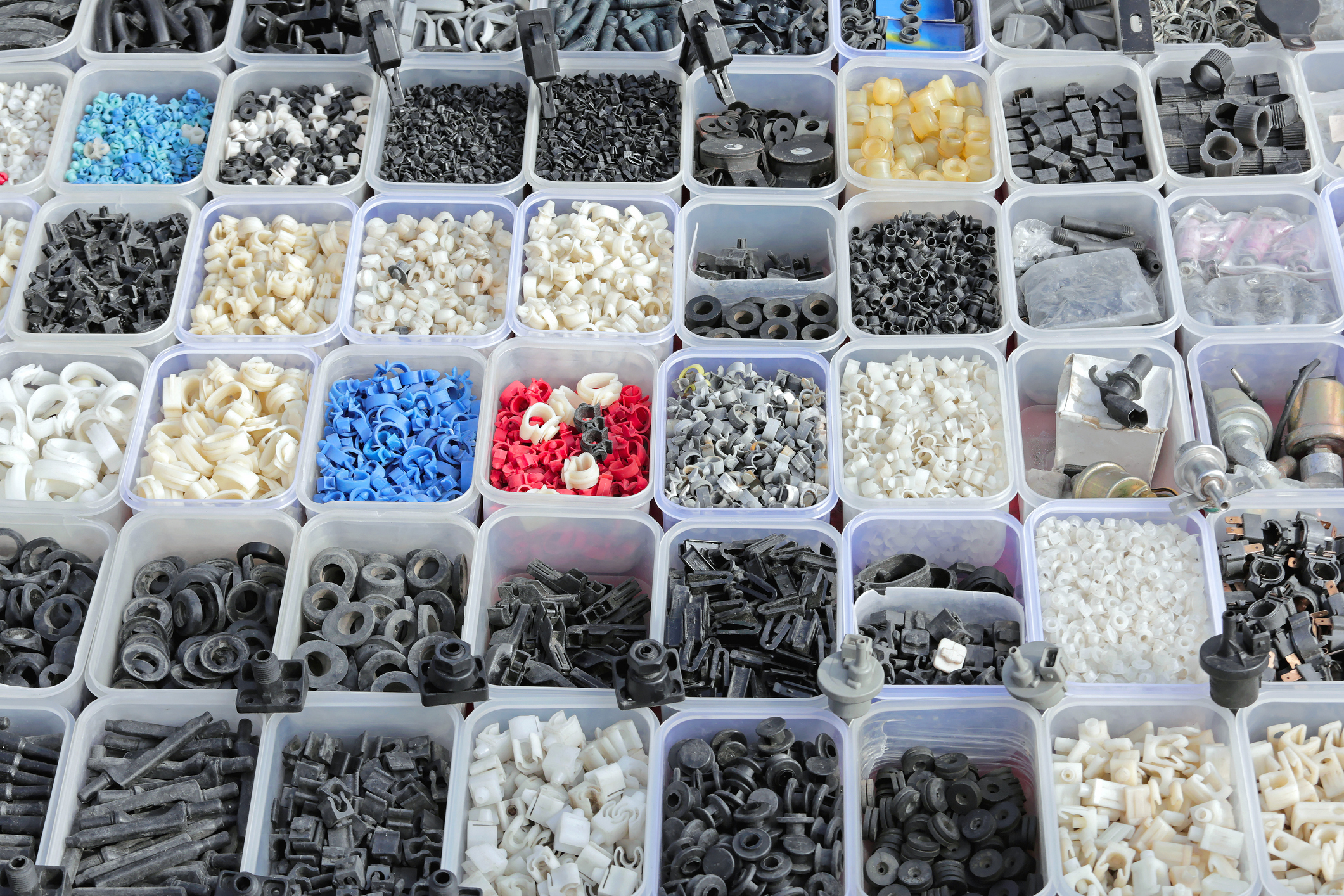
What Parts and Applications Are Best for Vibratory Feeders?
Vibratory feeders have been a workhorse of manufacturing automation for decades—and for good reason.
While newer technologies such as flexible feeders and robotic bin picking have expanded the options available to automation engineers, there are still many applications where a vibratory feeder is the simplest, fastest, and most economical solution.
The key is choosing the right feeding technology for the right part.
So, what types of parts are best suited for vibratory feeding? And when should manufacturers consider a vibratory bowl feeder instead of a flexible feeding system?
At Feedall Automation, we generally look at five things first:
- Part geometry
- Required orientation
- Production volume
- Cycle rate
- Product variety and expected future changes
Let’s look at each.
What Is a Vibratory Feeder?
A vibratory feeder uses controlled vibration to move bulk parts through a feeding system while tooling progressively separates, orients, and presents those parts for the next manufacturing operation.
A traditional system often consists of a vibratory bowl feeder, bulk hopper, feeder bowl tooling, discharge track, and escapement.
The objective is straightforward:
Take randomly loaded bulk parts and deliver them consistently in a known orientation.
When the part and application fit the technology, vibratory feeding can accomplish this extremely quickly and reliably.
1. Parts With a Distinct, Repeatable Geometry
Vibratory feeders work especially well when a part has physical characteristics that can be used to mechanically determine its orientation.
Examples might include:
- Screws and fasteners
- Washers
- Pins
- Bushings
- Bearings
- Clips
- Springs
- Caps and plugs
- Nuts
- Small stampings
- Electrical components
- Small machined components
Consider a simple fastener.
Its head, shaft, diameter, and length provide physical features that feeder tooling can use to reject incorrectly oriented parts while allowing correctly oriented parts to continue through the system.
The more mechanically distinguishable the orientation, the easier it generally is to create reliable feeder tooling.
2. High-Volume Applications With Limited Part Changes
One of the strongest applications for vibratory feeding is high-volume production of the same component.
Imagine an automated assembly machine producing millions of assemblies every year using the same screw, pin, cap, or bushing.
If that component isn’t expected to change, there may be little benefit to investing in the additional flexibility of a vision-guided flexible feeding system.
A properly designed vibratory feeder can run the same component for years.
This makes vibratory feeding particularly attractive for:
- Automotive component production
- Appliance manufacturing
- Consumer products
- Electrical component assembly
- Hardware and fastener manufacturing
- Medical device manufacturing
- High-volume assembly equipment
The economics become particularly attractive when tooling cost can be spread across millions of parts.
3. Applications Requiring Very High Feed Rates
Speed can be another major advantage.
Traditional vibratory feeding can deliver extremely high part rates when the component geometry and orientation requirements are favorable.
For example, an application requiring 100+ parts per minute may be an excellent candidate for a vibratory feeder—particularly when the same component will run continuously.
A robot picking individual components from a flexible feeder may introduce an unnecessary bottleneck in this type of application.
That leads to an important engineering principle:
Don’t add flexibility to an application that doesn’t need flexibility.
If the manufacturing requirement is simply to deliver one component very quickly and repeatedly, conventional vibratory feeding may be the better solution.
4. Small Parts That Are Easy to Mechanically Orient
Small components are another natural fit for vibratory bowl feeders.
Fasteners are a classic example.
A manufacturer may need to deliver screws into an assembly station head-first, shaft-first, or hanging from the head.
Mechanical tooling can often accomplish this orientation efficiently without cameras, robots, or sophisticated controls.
Other examples include:
| Part | Why Vibratory Feeding Can Work Well |
|---|---|
| Screws | Head and shaft create clear orientation features |
| Pins | Simple cylindrical geometry |
| Washers | Easy to singulate at high rates |
| Bushings | Consistent geometry and durable surfaces |
| Nuts | Defined geometry allows mechanical orientation |
| Caps | Distinct open/closed ends can aid orientation |
| Clips | Mechanical features can often be used for sorting |
| Bearings | Consistent geometry and high-volume applications |
| Small stampings | Features can be mechanically detected and oriented |
The exact answer, however, depends on more than simply the type of component.
Two parts that look nearly identical can behave very differently inside a feeder.
That’s why testing actual production parts remains an important part of feeder development.
5. Parts That Can Tolerate Contact With Each Other
Traditional vibratory feeders typically involve substantial part-to-part and part-to-tooling contact.
For durable metal components, this often isn’t a problem.
But it can become important when feeding:
- Highly cosmetic parts
- Polished surfaces
- Delicate components
- Coated parts
- Soft materials
- Components susceptible to scratching or damage
In those situations, feeder surfaces, coatings, vibration levels, and alternative feeding technologies should be evaluated carefully.
The question isn’t simply:
“Can we feed the part?”
The better question is:
“Can we feed the part at the required rate without damaging it?”
When Is a Vibratory Feeder Probably NOT the Best Choice?
Understanding the wrong applications is just as important.
Frequent Changeovers
If one production line needs to run five, ten, or twenty different components, dedicated mechanical tooling can become cumbersome.
Every new component may require additional tooling, change parts, setup time, and engineering.
A flexible feeder can become much more attractive because vision and robot programming can replace some of that dedicated mechanical tooling.
Parts That Frequently Change
Product designs change.
If the geometry of a component is likely to change during the life of the automation equipment, highly customized bowl tooling can create additional costs later.
Flexible feeding can make future changes easier to accommodate.
Difficult or Unpredictable Geometry
Some parts simply don’t behave well under vibration.
They may:
- Nest together
- Interlock
- Tangle
- Stack
- Overlap
- Wedge into tooling
- Have multiple very similar orientations
These characteristics can make conventional mechanical orientation difficult.
Applications Requiring Multiple Orientations
Sometimes there isn’t one “correct” orientation.
The robot may need to identify several acceptable orientations and determine how to pick each part.
That’s where vision-guided flexible feeding can become particularly powerful.
Vibratory Feeder vs. Flex Feeder: A Simple Decision Guide
A useful way to think about the decision is this:
| Application Characteristic | Vibratory Feeder | Flex Feeder |
|---|---|---|
| One dedicated part | Excellent | Good |
| Very high production volume | Excellent | Good |
| High feed rate | Excellent | Application dependent |
| Frequent product changeovers | Limited | Excellent |
| Future part changes expected | Limited | Excellent |
| Simple mechanical orientation | Excellent | Excellent |
| Complex/random orientation | Application dependent | Excellent |
| Multiple part families | Limited | Excellent |
| Minimal dedicated tooling desired | Limited | Excellent |
| Robot already required | Good | Excellent |
Neither technology is universally better.
The right feeder is the one that provides the required orientation, rate, reliability, flexibility, and total cost for the application.
Don’t Forget the Bulk-Handling System
Another common mistake is focusing exclusively on the bowl.
The vibratory feeder is only one component of a successful parts-feeding system.
Production systems may also require:
- Bulk hoppers
- Part elevators
- Prefeeders
- Linear tracks
- Escapements
- Accumulation
- Sensors
- Controls
- Integration with downstream automation
Bulk storage is particularly important.
Operators shouldn’t have to constantly refill a small bowl simply because the downstream machine consumes parts quickly.
A properly designed feeding system considers the entire path:
Bulk storage → metering → orientation → accumulation → presentation → machine or robot
That’s why Feedall evaluates the complete feeding process rather than simply selecting a bowl.
Modern Vibratory Feeding Is Changing
Vibratory feeding technology itself is also evolving.
Modern bowl feeder development can incorporate simulation, advanced design tools, and additive manufacturing to improve how tooling is developed and manufactured.
3D-printed tooling and feeder components can potentially reduce fabrication time while making complex geometries easier to manufacture.
Simulation can also help engineers understand how a component may behave before committing to final feeder tooling.
These technologies are making conventional vibratory feeding more capable and more predictable.
The Best Feeding Technology Depends on the Application
At Feedall, we manufacture multiple types of parts-feeding systems because we don’t believe every application should be forced into the same technology.
For a dedicated, high-volume component with predictable geometry, a vibratory feeder may still be the best solution available.
For a high-mix manufacturing environment, frequent product changeovers, difficult geometry, or applications where future flexibility is important, a Feedall Flex Feeder may provide significant advantages.
And for larger randomly oriented components, robotic bin picking may eliminate the need for traditional orientation equipment altogether.
The objective isn’t to choose the newest technology.
It’s to choose the simplest feeding technology that reliably accomplishes the manufacturing requirement.
Need Help Selecting the Right Parts-Feeding Technology?
Feedall Automation designs and manufactures vibratory feeders, Flex Feeders, conveyors, bulk feeding systems, bar feeders, orientation systems, and robotic feeding solutions.
Send us your part files, production rate, orientation requirements, and application details. Our engineers can help determine which feeding technology makes the most sense for your application.
Continue Learning
- When a Vibratory Bowl Feeder Is Still the Best Choice
- Smarter Part Feeding: How Simulation, 3D Printing & Flex Feeders Are Changing Automation
- Why Flexible Parts Feeding Is Replacing Vibratory Bowl Feeders
- How to Choose the Right Flex Feeder
- Feedall Flex Feeder vs. FlexiBowl: Capabilities That Matter
- Feedall vs. Asyril: Which Flex Feeding System Fits Your Application?