
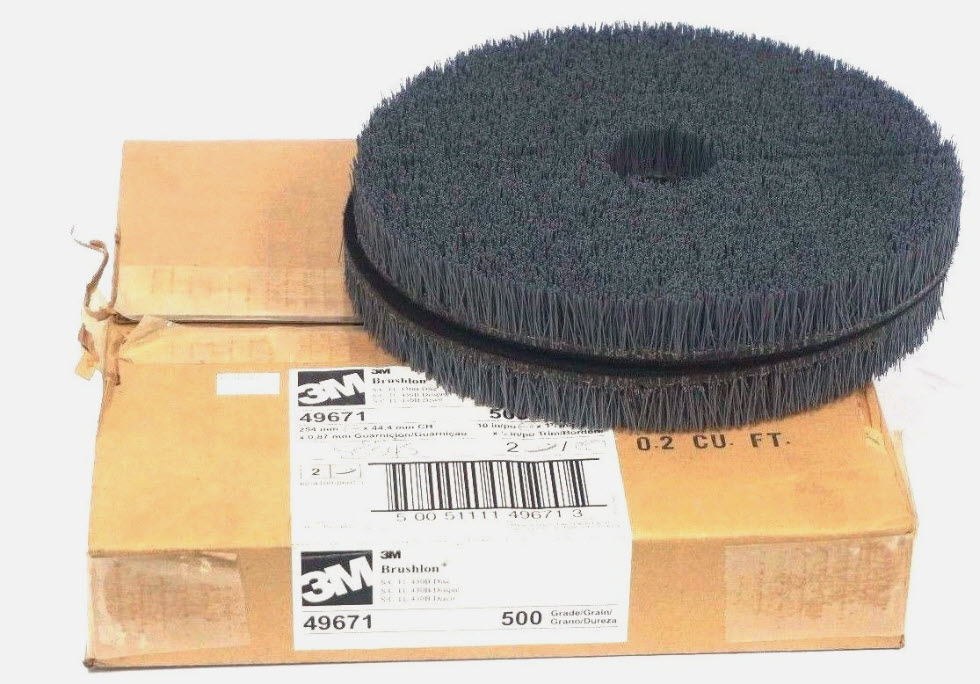
The Legacy of Brushlon®: Reviving One of Manufacturing’s Greatest Feeding Innovations
For decades, there was one material that quietly transformed the world of automated part feeding.
Most people outside of the vibratory feeder industry never knew its name.
But if you built vibratory bowl feeders, linear tracks, or precision automation equipment, you almost certainly did.
It was 3M Brushlon® 321B.
Long before flex feeders, AI vision systems, and collaborative robots became common, Brushlon changed the way manufacturers moved parts through automation.
Today, that product is gone.
At Feedall Automation, we believe its legacy shouldn’t disappear with it.
A Product That Changed an Industry
During the 1980s and 1990s, Brushlon became the preferred conveying surface for vibratory bowl manufacturers around the world.
Its angled nylon fibers allowed vibration to gently “walk” parts through feeding systems while dramatically reducing metal-to-metal contact.
The result was:
- Quieter equipment
- Less product damage
- Improved orientation
- Better control of delicate parts
- Lower maintenance
Many OEMs designed entire feeding systems around Brushlon because nothing else delivered the same combination of gentle handling and reliable conveying. Even today, industry competitors acknowledge that Brushlon became the standard material for vibratory feeders before its discontinuation around 2020.
Then It Disappeared
Around 2020, 3M quietly discontinued the Brushlon product line.
No public explanation was ever provided.
Manufacturers responded exactly as you’d expect.
They bought every roll they could find.
For several years, those inventories kept the industry moving.
But eventually, they began running out.
Suddenly, companies faced an uncomfortable reality:
How do you replace a product that entire machine designs were built around?
More Than Just a Brush
To someone unfamiliar with feeding systems, Brushlon looked like nothing more than a carpet.
It wasn’t.
Its engineering mattered.
Every characteristic influenced feeder performance:
- Fiber angle
- Fiber density
- Fiber stiffness
- Backing flexibility
- Fiber retention
- Wear resistance
Small changes in these characteristics could dramatically affect how parts accelerated, separated, and oriented themselves inside a feeder.
That’s why finding a true replacement has proven so difficult.
Feedall’s Mission
At Feedall, we have spent nearly 80 years helping manufacturers solve feeding problems.
When Brushlon disappeared, we weren’t simply looking for another supplier.
We were looking for a product worthy of carrying on its legacy.
That search eventually led us to Mink Bürsten in Germany.
Building on the Brushlon Legacy
Rather than copying Brushlon, Mink engineered the Slide-Brush® specifically for modern vibratory conveying.
According to Mink, the Slide-Brush offers:
- Uniform conveying in both spiral and linear tracks
- Up to 40% noise reduction
- Improved conveying performance
- Soft fibers that reduce scratches
- Angled fibers capable of significantly increasing conveying speed
- Highly flexible backing material for easier installation and longer service life
In many respects, it doesn’t simply replace Brushlon.
It builds upon what made Brushlon successful.
Feedall Didn’t Stop at Bowl Feeders
One reason Feedall chose Mink is because we believe the future of part feeding requires flexibility.
Today, the same Slide-Brush technology is used not only in vibratory bowl feeders but also throughout the Feedall Flex platform.
Instead of permanently bonding one surface to a feeder, Feedall developed interchangeable Modular Surface Kits, allowing customers to optimize the conveying surface for different parts and applications. Available options include Slide-Brush®, Heavy Duty Slide-Brush®, Food Grade Slide-Brush®, Soft Brush, Thermoplastic, and Anti-Roll surfaces.
This gives manufacturers something Brushlon alone never could:
A feeding surface tailored to the application.
Why Manufacturing Quality Matters
Not every replacement brush is created equally.
As engineers, we evaluated multiple alternatives before selecting Mink.
Among the differences we observed were:
- Higher brush density
- Robust rubber backing
- Chemically bonded fiber construction
- Improved resistance to fiber pull-out
- More consistent manufacturing quality
These details directly affect conveying consistency, durability, and long-term performance in production environments. Feedall’s internal engineering comparison documents these observed construction differences.
Reviving More Than a Product
This isn’t simply about selling brush material.
It’s about preserving decades of engineering knowledge.
Thousands of vibratory feeding systems around North America still depend on Brushlon-style conveying surfaces.
By partnering exclusively with Mink Bürsten in North America, Feedall is helping ensure those systems continue running while giving machine builders access to a next-generation solution.
Sometimes innovation isn’t about replacing the past.
Sometimes it’s about preserving the best ideas—and making them even better.
Continue Learning
- The Best Replacement for 3M Brushlon® 321B
- How Vibratory Bowl Feeders Work
- Choosing the Right Feeder Surface
- Modular Surface Kits Explained
- Feedall Flex: Flexible Feeding for Modern Automation
- Vibratory Bowl Feeders vs. Flex Feeders
- Common Causes of Part Feeding Problems