
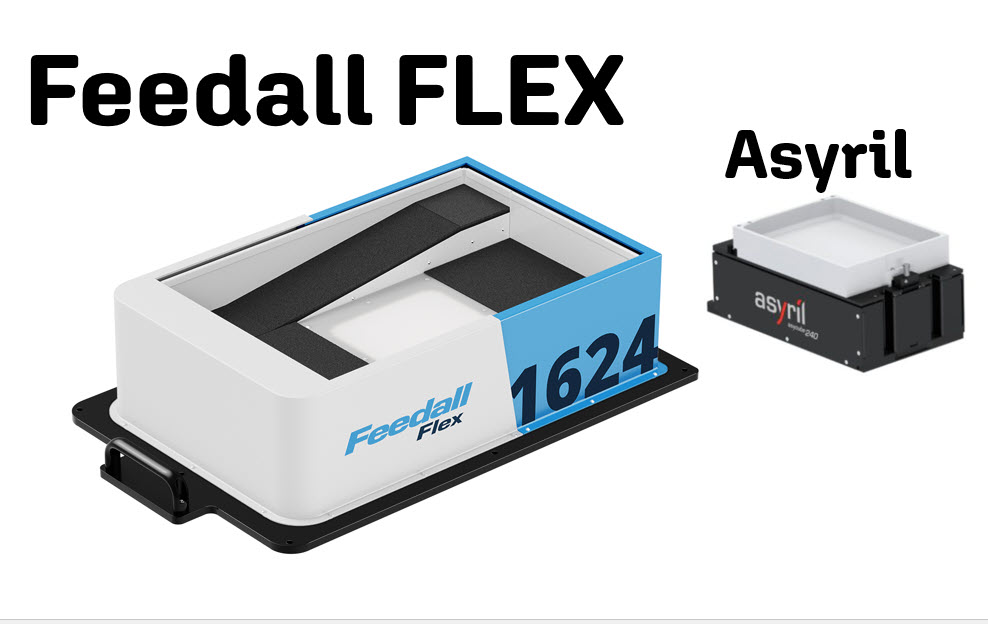
Feedall vs Asyril: Which Flex Feeding System Fits Your Application?
Flexible feeding has become a critical technology for manufacturers looking to automate high-mix production, reduce changeover time, and get more productivity from industrial and collaborative robots.
Two names that often come up when manufacturers evaluate flexible feeding are Feedall Automation and Asyril.
Both companies offer proven technologies for presenting randomly oriented parts to vision-guided robots. But the systems approach the problem differently.
Asyril has built a strong platform around its Asycube flexible feeders and EYE+ vision ecosystem, particularly for small and precision components.
Feedall takes a broader part-presentation and robot-feeding approach built around three core technologies:
1. Feedall Flex mechanically controls and presents the part.
2. Customized modular feeder surfaces—including innovative fiber technology from Feedall’s strategic partner Mink-Bürsten—are selected around the behavior of the actual component.
3. Feedall Guide Eye, developed through Feedall’s strategic partnership with SICK Sensor Intelligence, uses SICK PLOC2D and SIM technology for vision, processing, and robot guidance.
That distinction is important.
The Feedall philosophy isn’t simply:
Put parts on a surface and let vision figure them out.
It is:
Control the part first. Then let vision guide the robot.
The Real Problem Isn’t the Robot
Modern industrial robots are extremely repeatable.
But a robot can only pick a part that has been presented in a usable position.
In many automation projects, the hidden bottleneck isn’t the robot. It’s part presentation.
Parts can:
- Overlap
- Nest
- Roll
- Tangle
- Stack
- Flip unpredictably
- Reflect light
- Land on the wrong face
- Move differently because of weight or surface condition
When those variables aren’t controlled, cycle times become inconsistent and robot utilization falls.
That is why the performance of a flexible feeding system should not be judged solely by the feeder itself.
The complete process includes:
Bulk Storage → Metering → Separation → Orientation → Surface Control → Vision → Robot Guidance → Picking
Feedall engineers around that complete process.
Understanding the Asyril Approach
Asyril’s flexible feeding architecture is centered around its Asycube product family.
Asycube feeders use three-axis vibration to move and distribute parts across the feeding surface. The platform covers a broad range of feeder sizes and is particularly well established in applications involving:
- Electronics
- Medical components
- Small precision components
- Delicate parts
- Precision assembly
- High-mix production
Asyril also offers its EYE+ ecosystem for vision, feeder control, calibration, and robot communication.
For extremely small parts and precision assembly applications, Asyril can be an excellent solution.
Feedall’s differentiation becomes more significant as the application demands greater physical control over the part itself.
Feedall Flex: Don’t Just Move the Part. Control It.
Feedall brings decades of experience in industrial part feeding to flexible robotic automation.
Feedall Flex uses a recirculating vibratory feeding architecture with dedicated functional zones for loading, metering, reorientation, separation, high-contrast presentation, and robot picking.
The feeder cycles so the vision system can image the picking area, identify available components, and provide usable coordinates to the robot.
Parts that aren’t pickable simply continue circulating through the feeder where they can be separated, reoriented, or exposed differently on the next pass.
That creates an important distinction:
Feedall actively manages how the part moves through the feeding process.
The company’s published Flex positioning emphasizes part separation, orientation, face selection, and part control specifically to increase robot pickability and support predictable cycle times.
And one of the most important tools Feedall uses to achieve that control is the feeder surface itself.
The Surface Is Part of the Feeding Technology
Here’s a simple robot-feeding fact:
Different parts behave differently on different surfaces.
A steel shaft doesn’t behave like a plastic molded component.
A heavy forged part doesn’t behave like a delicate cosmetic component.
A cylindrical part may roll continuously on one surface while stabilizing almost immediately on another.
A complicated geometry may interlock with neighboring components unless the feeder surface helps create the correct movement.
That is why Feedall does not treat the feeder surface as an afterthought.
Feedall offers customized modular surface kits selected around the requirements of the actual part.
The current surface family includes:
- Soft Brush — for gentle part movement
- Slide-Brush® — for heavy parts
- Slide-Brush® HD — for complex parts
- Thermoplastic — for abrasion protection
- Slide-Brush® FG — for food-grade requirements
- Anti-Roll — for cylindrical components
Feedall’s brochure makes the design philosophy explicit: different types of parts require different feeder surfaces, so the company offers modular surface kits that can be matched to specific part requirements.
Feedall + Mink-Bürsten: Engineering the Contact Between Part and Feeder
This is where another important Feedall strategic relationship enters the system.
Feedall has a strategic partnership with Mink-Bürsten, a specialist in innovative fiber and brush technologies, and holds exclusive North American distribution for the technology used in these Feedall applications.
Feedall incorporates customized Mink fiber materials into its modular surface solutions to help engineer how components physically interact with the feeder.
That may sound like a small detail.
It isn’t.
The surface directly affects:
- Friction
- Part acceleration
- Sliding behavior
- Rolling
- Separation
- Rotation
- Face selection
- Impact
- Part protection
- Stabilization
That means the surface can influence how quickly Feedall creates the next usable robot pick.
Instead of expecting software to compensate for every unpredictable part condition, Feedall attacks the problem mechanically first.
Control the part. Increase pickability. Give vision better information. Keep the robot moving.
Why Part Control Can Improve Cycle Time
Imagine ten parts enter the picking area.
A vision system may be able to identify all ten geometrically.
But that doesn’t mean all ten are actually usable robot picks.
Some may be touching.
Some may be on the wrong face.
Some may be nested.
Some may be rolling.
Some may not provide enough exposed geometry for reliable EOAT engagement.
The objective of the flexible feeder therefore isn’t merely to create visible parts.
The objective is to create pickable parts.
Feedall’s combination of:
- Controlled recirculation
- Separation zones
- Reorientation
- Customized feeder surfaces
- High-contrast presentation
- Vision guidance
is intended to increase the percentage of parts that become useful robot picks.
And every additional usable pick can help reduce wasted feeder cycles and improve effective robot cycle time.
Feedall’s Vision Strategy: Strategic Partnership With SICK
Once Feedall has created a stable, separated, pickable component, the next question is:
Where exactly is the part?
For that, Feedall has formed a strategic partnership with SICK Sensor Intelligence.
Feedall and SICK jointly commercialize a system combining Feedall Flex feeding technology with SICK PLOC2D and SIM technology, branded as Feedall Guide Eye. The partnership combines mechanical feeding, intelligent vision, and robot guidance in one platform.
The architecture is straightforward:
Feedall Flex
controls and presents the component.
↓
Mink-Bürsten modular surface technology
helps manage how the specific part moves.
↓
SICK PLOC2D
detects the part’s location and orientation.
↓
SICK SIM
provides edge computing and feeder-control functionality.
↓
Robot Guidance
delivers usable part coordinates to the robot.
↓
Robot Pick
That’s a very different philosophy from expecting vision alone to solve an uncontrolled bulk-parts problem.
Feedall Guide Eye: Built Around SICK PLOC2D and SIM
Feedall Guide Eye is the company’s integrated 2D robot-guidance solution developed with SICK.
The package includes:
- SICK PLOC2D camera
- SICK SIM edge computing device
- Calibration aids
- Camera bracket
- Required cables
- Integrated Feedall feeder control and robot-guidance workflow
PLOC2D detects the position and orientation of parts and converts those detections into real-world coordinates the robot can use.
The key is what happens before that image is taken.
Feedall has already worked to:
separate → orient → stabilize → present
the component.
That can allow an economical 2D vision system to solve applications that might otherwise require more complex vision technology.
Feedall still offers 3D vision for applications that genuinely require it.
The objective isn’t to use the most sophisticated camera available.
It’s to solve the application with the simplest reliable architecture.
Feedall + SICK Is Also About Integration Time
Another advantage of the Feedall/SICK partnership is reducing the amount of custom engineering required to connect the feeder, camera, controls, and robot.
Guide Eye is designed around:
- Feeding
- Vision
- Feeder control
- Calibration
- Coordinate generation
- Robot communication
Feedall states that Guide Eye setup can be completed in approximately 20 minutes, even without extensive machine-vision experience.
That can matter considerably for:
- System integrators
- Robot OEMs
- Machine builders
- Manufacturers deploying multiple automation cells
because integration time is one of the hidden costs of robotic automation.
Feedall’s Physical Range Is Also Different
Feedall Flex covers a particularly broad range of industrial component sizes and weights.
| Feedall Model | Part Size | Max Individual Part Weight | System Payload | Pickable Area |
|---|---|---|---|---|
| Flex 612 | 2–65 mm | 100 g | 4 kg | 72 in² |
| Flex 1018 | 2–100 mm | 250 g | 10 kg | 180 in² |
| Flex 1624 | 5–175 mm | 0.6 kg | 15 kg | 384 in² |
| Flex 3042 | 10–350 mm | 1.2 kg | 20 kg | 1,260 in² |
That gives Feedall a particularly strong position in applications involving:
- Machined parts
- Stampings
- Castings
- Shafts
- Fittings
- Fasteners
- Automotive components
- Hardware
- CNC workpieces
- Larger industrial components
The larger the component becomes, the more important surface behavior, separation area, orientation control, and available pickable area become.
Feedall vs Asyril: The Practical Comparison
| Application Requirement | Feedall Flex + Guide Eye | Asyril Asycube + EYE+ |
| Micro / extremely small components | Application dependent | Excellent fit |
| Precision electronics | Application dependent | Strong fit |
| Medium industrial components | Strong fit | Strong fit |
| Large industrial parts | Excellent fit | Application dependent |
| Heavy parts | Strong Feedall capability | Verify application |
| Part-specific feeder surfaces | Customized modular surfaces | More standardized feeder approach |
| Fiber/brush surface engineering | Mink-Bürsten technology | Not a core platform feature |
| Mechanical part control | Major design emphasis | Vibration-based presentation |
| Face selection / orientation | Major design emphasis | Vision + feeder motion |
| Large pickable area | Strong Feedall capability | Model dependent |
| 2D robot guidance | SICK PLOC2D | EYE+ |
| Edge processing/control | SICK SIM | EYE+ controller |
| Vision partnership | Strategic partnership with SICK | Asyril ecosystem |
| Robot compatibility | Broad multi-brand support | Broad multi-brand support |
| High-mix manufacturing | Strong fit | Strong fit |
| U.S. feeder engineering/manufacturing | Yes | Swiss manufacturer |
| Application-specific testing | Feedall robotics lab | Application dependent |
The difference is not simply that one feeder vibrates differently from another.
The more meaningful difference is how much of the part presentation problem the feeder manufacturer takes responsibility for.
Feedall Engineers Around the Actual Part
This may be the most important distinction for a manufacturer or system integrator.
With Feedall, the evaluation isn’t simply:
“Which feeder size does this part fit on?”
The questions become:
- How does the part move?
- Does it roll?
- Does it nest?
- Does it tangle?
- Which face should the robot pick?
- Which surface produces the correct behavior?
- How much separation area is necessary?
- Does the part need backlighting?
- Does the part require a detangler?
- How should bulk parts be metered?
- Can 2D PLOC2D guidance solve it?
- Does the application require advanced 3D guidance?
- What EOAT provides the most reliable pick?
That’s part feeding engineering—not simply feeder selection.
And it explains why Feedall emphasizes application testing.
Feedall maintains a 2,000-square-foot robotics lab where actual customer components can be tested and feeding challenges evaluated before deployment.
Which Flex Feeding System Fits Your Application?
For extremely small components, electronics, and precision micro-assembly applications, Asyril’s Asycube + EYE+ architecture can be an excellent choice.
But as components become larger, heavier, more geometrically difficult, or more dependent on how they physically move across the feeder, the application becomes less about simply locating a part and more about controlling it.
That is where Feedall’s architecture becomes particularly compelling.
Feedall combines:
- 75+ years of part-feeding experience
- Feedall Flex recirculating part control
- customized modular surfaces incorporating Mink-Bürsten fiber technology
- SICK PLOC2D vision
- SICK SIM processing and feeder control
- broad robot compatibility
into one robot-feeding platform.
The guiding principle is simple:
Control the Part Before You Ask the Robot to Pick It
The best robotic feeding cell isn’t necessarily the one with the most advanced camera.
It’s the one that consistently gives the robot something it can pick.
That’s why Feedall focuses on the complete sequence:
Meter it.
Separate it.
Orient it.
Control it.
See it.
Guide it.
Pick it.
And then do it again—fast enough to meet production.
Ready to Put Your Parts to the Test?
Don’t choose a flexible feeder based only on a specification sheet.
Send Feedall your actual parts.
Our application engineers can evaluate:
- Part geometry
- Weight
- Surface condition
- Orientation requirements
- Required cycle time
- Feeder surface
- Bulk storage
- Separation requirements
- Vision strategy
- Robot compatibility
- EOAT requirements
We’ll help determine the appropriate Feedall Flex platform, the right modular surface configuration, and whether Guide Eye with SICK PLOC2D or a more advanced vision configuration makes the most sense.
Because successful robot feeding doesn’t begin with the robot.
It begins by controlling the part.