
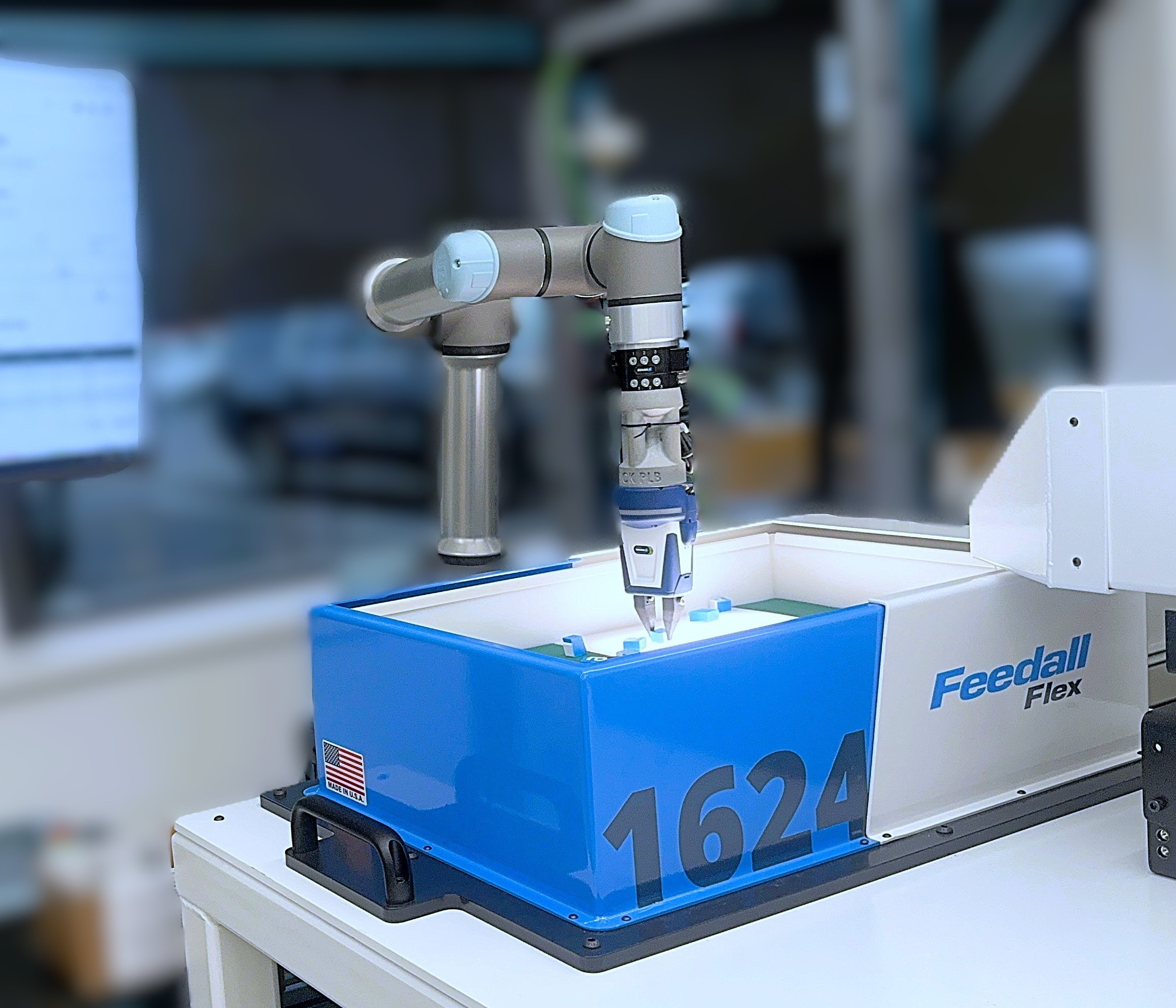
How to Choose the Right Flex Feeder
Manufacturers are under more pressure than ever to produce a wider variety of products while maintaining shorter lead times, higher quality standards, and lower operating costs. Traditional vibratory bowl feeders still have their place, but many manufacturers are turning to the flex feeder because it provides the flexibility needed for today’s production environments.
The challenge is that not all flex feeders are created equal.
Whether you’re automating a new assembly line, adding robotics, or replacing a vibratory bowl feeder, selecting the right flex feeder can have a significant impact on productivity, changeover time, and long-term operating costs.
In this guide, we’ll explain the most important factors to consider when choosing a flex feeder and how to determine which solution best fits your application.
What Is a Flex Feeder?
A flex feeder is an automated part presentation system that randomly distributes parts across a programmable surface, allowing a robot equipped with vision guidance to identify, pick, and present individual components for downstream automation.
Unlike dedicated bowl feeders that require custom tooling for each part, a flex feeder can often run multiple parts with little or no tooling changes.
This makes flex feeders ideal for:
- High-mix manufacturing
- Low-to-medium production volumes
- Frequent product changeovers
- Robotic assembly
- Machine tending
- Packaging automation
- Vision inspection
1. Start with Your Parts
The first question should never be:
“Which flex feeder should I buy?”
Instead ask:
“What parts am I trying to feed?”
Every application begins with the characteristics of the part.
Consider:
- Part size
- Weight
- Material
- Surface finish
- Shape complexity
- Symmetry
- Fragility
- Required orientation
Examples:
Small precision components
- Electronic connectors
- Medical devices
- Fasteners
These often require precise singulation and consistent spacing.
Larger industrial components
- Castings
- Stampings
- Machined parts
These require a feeder capable of moving heavier components without sacrificing reliability.
2. Determine Your Required Throughput
One of the biggest misconceptions is that flex feeders are always slower than vibratory bowls.
That simply isn’t true.
Today’s flex feeders regularly support robotic applications exceeding 30–60 picks per minute, while specialized systems can achieve even higher throughput depending on the part.
Ask yourself:
- Parts per minute?
- Robot cycle time?
- Is the feeder the bottleneck?
- Future production requirements?
A properly designed system should meet today’s production goals while leaving room for growth.
3. Consider Part Changeovers
One of the biggest advantages of a flex feeder is reduced changeover time.
If your operation runs:
- Multiple SKUs
- Short production runs
- Seasonal products
- Contract manufacturing
…then changeover speed becomes one of the largest drivers of ROI.
Traditional bowl feeders often require:
- New bowls
- New tracks
- Mechanical adjustments
- Tooling changes
A flex feeder can often switch recipes in minutes.
This capability enables true Multi-Feed manufacturing, where one feeder supports multiple products instead of dedicating one feeder to every part.
4. Evaluate Vision Integration
Modern flex feeders rely heavily on machine vision.
The vision system should provide:
- Reliable part detection
- Fast image processing
- Multiple orientation recognition
- Robot communication
- Easy calibration
Look for systems designed around industrial vision platforms rather than aftermarket add-ons.
A tightly integrated vision solution improves:
- Pick success
- Robot utilization
- Overall equipment effectiveness (OEE)
5. Match the Feeder to Your Robot
Your robot and your feeder should function as one integrated system.
Verify compatibility with:
- FANUC
- ABB
- Universal Robots
- Epson
- Yaskawa
- KUKA
- Kawasaki
- Mitsubishi
- Omron
Look for suppliers that provide complete robot integration rather than requiring multiple vendors to solve communication issues.
6. Think Beyond Today’s Application
Many manufacturers purchase automation to solve one immediate problem.
Six months later they’re trying to feed another product.
Ask:
- Will this feeder support future products?
- Can additional recipes be added?
- Can software updates expand capabilities?
- Is it scalable?
Buying flexibility today reduces future capital spending.
7. Don’t Ignore Part Presentation Quality
The goal isn’t simply moving parts.
The goal is presenting parts that are:
- Separated
- Visible
- Pickable
- Repeatable
A well-designed flex feeder minimizes:
- Part overlap
- Stacking
- Dead zones
- Robot searching time
Better part presentation leads directly to faster cycle times.
8. Noise Matters More Than You Think
Traditional vibratory bowls generate constant vibration and noise.
Flex feeders typically operate much quieter because they use programmable motion rather than continuous vibration.
Benefits include:
- Improved operator comfort
- Better communication on the production floor
- Reduced workplace fatigue
- Easier integration into collaborative robotic cells
9. Consider Total Cost of Ownership
The purchase price is only one part of the equation.
Evaluate:
- Changeover labor
- Spare parts
- Maintenance
- Future tooling
- Downtime
- Programming
- Operator training
Over the life of the equipment, a flexible system often delivers a substantially lower total cost than maintaining multiple dedicated bowl feeders.
10. Choose a Supplier—Not Just a Machine
A flex feeder is part of a larger automation system.
Choose a supplier that offers:
- Application engineering
- Feasibility testing
- CAD support
- Robot integration
- Vision expertise
- On-site commissioning
- Long-term technical support
The best suppliers become automation partners—not simply equipment vendors.
Questions to Ask Before Buying a Flex Feeder
Before selecting a solution, ask your supplier:
- What part sizes can the feeder handle?
- What throughput has been demonstrated for similar applications?
- Can the feeder support multiple part families?
- How long do recipe changeovers take?
- What vision system is included?
- Which robots are supported?
- What training is provided?
- What service is available after installation?
- Can I see a proof-of-concept before purchasing?
The answers will often reveal the difference between an off-the-shelf product and a fully engineered automation solution.
Why Manufacturers Choose Feedall Flex Feeders
Feedall has spent decades solving complex part-feeding challenges, from traditional feeding systems to advanced robotic automation.
Our latest generation of Flex Feeders was designed to deliver:
- Fast, repeatable part presentation
- Quick changeovers for multi-part production
- Integrated industrial vision
- Quiet operation
- High reliability
- Compatibility with leading industrial robots
- Engineering support from concept through production
Whether you’re replacing a vibratory bowl feeder or designing a new robotic workcell, Feedall can help you identify the right solution for your application.
Conclusion
Choosing the right flex feeder isn’t about selecting the newest technology—it’s about selecting the right technology for your manufacturing process.
By evaluating your parts, production requirements, vision system, robot integration, and long-term flexibility, you can invest in a solution that improves productivity today while adapting to tomorrow’s manufacturing demands.
If you’re considering flexible feeding for your next automation project, working with an experienced application engineering team can help ensure you achieve the highest return on your investment.