
Last week we covered when robotic bin picking is the right call in the first place. This week assumes you have already answered that question and are looking at actual systems. That is where a lot of automation projects go sideways, because bin picking systems that look identical in a demo video can perform very differently once they hit your parts, your lighting, and your production schedule.
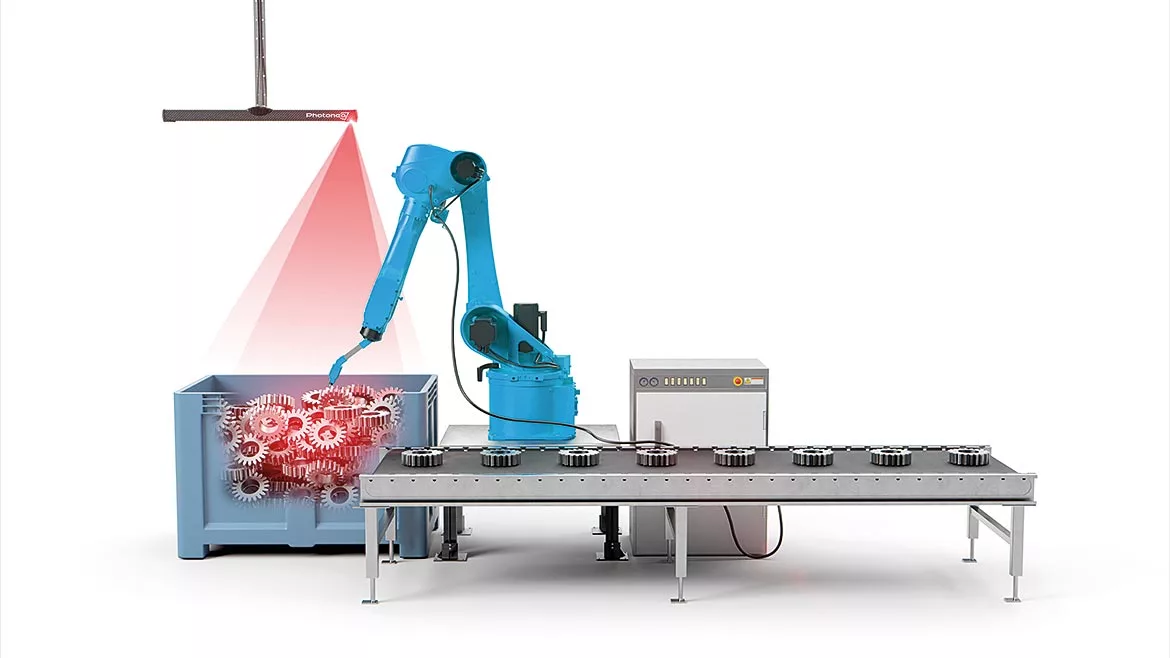
A bin picking system is not one product. It is a vision system, a picking algorithm, a robot, and a gripper, working together, sourced from one vendor or stitched together from several. What to look for depends less on brand names and more on a handful of factors that actually predict whether the system will still be running smoothly a year after installation.
Start With Your Parts, Not the Technology
Before comparing vision hardware or software, get specific about what the system will actually be picking. Size, material, and surface finish all change which systems are realistic candidates. Small, lightweight parts favor vacuum grippers and faster cycle times. Heavy or irregular castings need more robust path planning and stronger end-of-arm tooling. Reflective, polished, or transparent surfaces remain difficult for most 3D vision systems on the market, so if your parts fall into that category, ask every vendor how their system specifically handles reflectivity rather than accepting a general answer.
Vision Technology: What Is Actually Under the Hood
Not all 3D vision is equal. Structured light and time-of-flight sensors were the standard for years, but stereo vision paired with AI-based matching has become the more robust and cost-effective approach for handling cluttered, randomly oriented parts in factory lighting. Ask vendors directly which approach their system uses, how it performs under your facility’s actual lighting rather than a controlled lab, and how camera placement works. Feedall’s Moonflower picking software, for example, supports flexible camera placement, mounted between bin locations or directly on the robot arm, which matters once you are trying to fit a cell into an existing footprint rather than designing a cell from scratch.
Cycle Time Versus Accuracy
Most bin picking applications run in a five to fifteen second cycle per part, and it is worth treating that range with some suspicion rather than taking a vendor’s fastest-case number at face value. A system tuned purely for speed will mispick more often, and a mispick costs more than the extra second it would have taken to verify the grasp, because it can damage the part, stall the cell, or require manual intervention. Ask for cycle time numbers based on your actual parts, not a vendor’s easiest demo part.
Robot and Gripper Compatibility
Before you get attached to a particular vision and software combination, confirm it actually works with the robot brands you already run or plan to run. Protocol compatibility with major robot manufacturers is not universal, and older or proprietary robot controllers can add real integration time, which matters just as much for machine tending equipment downstream of the pick as it does for the bin picking cell itself. The same applies to grippers. Vacuum grippers suit flat or smooth parts, parallel or finger grippers handle irregular shapes, and soft grippers protect delicate or easily damaged parts. A system that only supports one gripper type is a system that may not scale to your next part number.
One Vendor or Several
This is the single question that predicts implementation pain more than any other. Some bin picking projects are assembled from a camera vendor, a software vendor, a robot integrator, and a systems house, each responsible for their own piece and none fully responsible for the whole. When something does not work, no one owns the fix. An integrated approach, where the vision hardware, picking software, and mechanical integration come from a single accountable source, is significantly easier to implement and troubleshoot. Feedall pairs its own Smart Bin Technology and Mizar 3D camera with Moonflower picking software as one accountable bin picking system rather than a collection of parts assembled after the fact.
The Real Cost of Ownership
The sticker price on a bin picking system is rarely the full cost. Budget for the robot, gripper, mechanical structure and electrical integration, not just the vision and software license. Integration labor is the most commonly underestimated line item in a bin picking project. Ask what happens when you add a new part number: some vendors handle it as a software update, while others require a paid retraining engagement or a new CAD submission for every SKU. That difference compounds quickly in a high-mix production environment.
How Fast Can You Actually Get to Production
Feature lists do not predict how quickly a system reaches stable production, and that timeline can run from a few weeks to several months depending on the vendor and the complexity of your parts. Before committing, request a proof of concept with your actual parts rather than the vendor’s easiest demo case. A vendor confident in their system will welcome that test. One that resists it is telling you something, a pattern independent buyer’s guides such as Eureka Robotics have flagged as well.
What to Ask, and Why It Matters
The questions below are worth asking every vendor you evaluate, side by side, before you sign anything.
| Question to Ask | Why It Matters | Red Flag Answer |
| What vision technology do you use, and how does it perform in our lighting? | Structured light/time-of-flight struggle with reflective, cluttered parts; stereo vision + AI matching is more robust | “It works in every environment” with no lighting test offered |
| What’s your real cycle time on our parts, not your demo part? | Demo parts are chosen to look good; real cycle time on your parts can run 2-3x slower | Refuses to test with your actual parts |
| Which robots and grippers does the system support? | Protocol incompatibility and single-gripper support limit scaling to future part numbers | Vague “compatible with most robots” with no specifics |
| Is this an integrated system, or pieced together from several vendors? | Multi-vendor stacks create finger-pointing when something breaks | No single point of contact for support |
| What does it cost to add a new part number later? | Some vendors charge for retraining or a new CAD submission per SKU — that adds up in high-mix production | “We’ll figure that out later” |
| Can we run a proof of concept with our own parts? | A confident vendor demonstrates on your parts before you commit | Only offers demos with their own parts |
Is Your Bin Picking Project Ready to Evaluate Vendors? A Quick Checklist
☐ You have defined your parts by size, material, and surface finish, including any reflective or entangled parts
☐ You know your required cycle time based on your actual production rate, not a vendor’s best case
☐ You have confirmed which robot brands and gripper types the system needs to support
☐ You know whether the vendor offers an integrated system or expects you to coordinate multiple suppliers
☐ You have asked what it costs, in time and money, to add a new part number after installation
☐ You have requested a proof of concept with your own parts before committing
Checking most of these boxes before your first vendor call will save time in every conversation that follows, and it will make the differences between systems much easier to see.
How Feedall Approaches These Criteria
Feedall has spent more than 75 years building part feeding automation, and that same discipline shapes how the company builds and sells bin picking systems. Rather than assembling a vision camera from one supplier and software from another, Feedall pairs its own Mizar 3D camera with Moonflower picking software and Smart Bin Technology as one integrated, accountable system. For applications that need it, Feedall also builds complementary equipment, a charging conveyor to meter parts at a controlled rate, or a custom bulk elevator hopper to stage parts before picking, alongside flex feeders, bar feeders, and part feeders for applications where bin picking is not the right fit at all. The recommendation comes from the application, not from what is easiest to sell.
The Bottom Line
The vendors that look best on paper are not always the ones that perform best on your actual parts, in your actual facility, at your actual volume. Get specific about your parts before you evaluate technology, ask every vendor the same set of pointed questions about vision, compatibility, cost, and integration, and insist on a proof of concept before you commit. That process will tell you more about which system is right for you than any spec sheet.
Talk to a Feedall automation engineer about your parts and get a straight answer on what a working bin picking cell would actually cost and how long it would take to reach production.
FAQ
What is a realistic cycle time for a bin picking system?
Most applications run five to fifteen seconds per part. Be skeptical of a vendor’s fastest-case number until you’ve seen it demonstrated on your own parts, since a system tuned purely for speed can mispick more often.
Do I need a different bin picking system for different part types?
Not necessarily, but you should confirm upfront what it costs — in time and money — to add a new part number. Some systems handle new SKUs with a software update; others require a paid retraining engagement for each one.
Should I buy the vision, software, and robot from one vendor or separately?
An integrated system from a single accountable vendor is generally easier to implement and troubleshoot than a stack assembled from multiple suppliers, where responsibility for a problem can be unclear.
What does a bin picking system really cost beyond the sticker price?
Budget for the robot, gripper, mechanical structure, and electrical integration in addition to the vision and software license. Integration labor is the most commonly underestimated cost in a bin picking project.
Can I test a bin picking system with my own parts before buying?
You should ask for exactly that. A proof of concept run with your actual parts, not the vendor’s easiest demo case, is the clearest signal of how the system will perform in your facility.
Continue Learning
When Should You Use Robotic Bin Picking? — last week’s post on whether bin picking is the right call before you start evaluating vendors.
Random Bin Picking: Challenges and a Solution — a deeper look at why random bin picking remains one of the hardest unsolved problems in automation.
Eye on the Future: Bin Picking Vision Systems — how vision hardware is evolving and why Feedall prioritizes validated performance over hype.