
Reducing Changeover Time in Automated Feeding Systems: The Competitive Advantage of Multi-Feed Manufacturing
Manufacturers have traditionally measured automation success by one simple metric: production speed.
How many parts per minute?
How many assemblies per hour?
While throughput will always be important, today’s manufacturers are discovering that another metric often has an even greater impact on profitability:
Changeover time.
As product variety increases, lot sizes shrink, and customer expectations continue to evolve, reducing changeover time in automated feeding systems has become one of the most effective ways to improve manufacturing productivity.
The feeding system is often the difference between a production line that keeps moving—and one that spends valuable hours waiting for the next setup.
The Hidden Cost of Long Changeovers
Every minute a production line sits idle costs money.
During a product changeover, manufacturers frequently lose valuable production time while operators:
- Replace bowls and tooling
- Install new tracks
- Adjust escapements
- Verify part orientation
- Test the feeder
- Fine-tune mechanical settings
Even experienced technicians can spend 30 minutes to several hours completing a single feeder changeover.
Multiply that across several changeovers each week, and the lost production time quickly becomes one of the largest hidden costs in an automated assembly operation.
Reducing changeover time in automated feeding systems is no longer simply an operational improvement—it’s becoming a competitive advantage.
Reducing Changeover Time Enables Multi-Feed Manufacturing
Modern manufacturing looks very different than it did twenty years ago.
Customers now expect:
- More product variations
- Increased customization
- Smaller production runs
- Faster delivery
- Shorter product life cycles
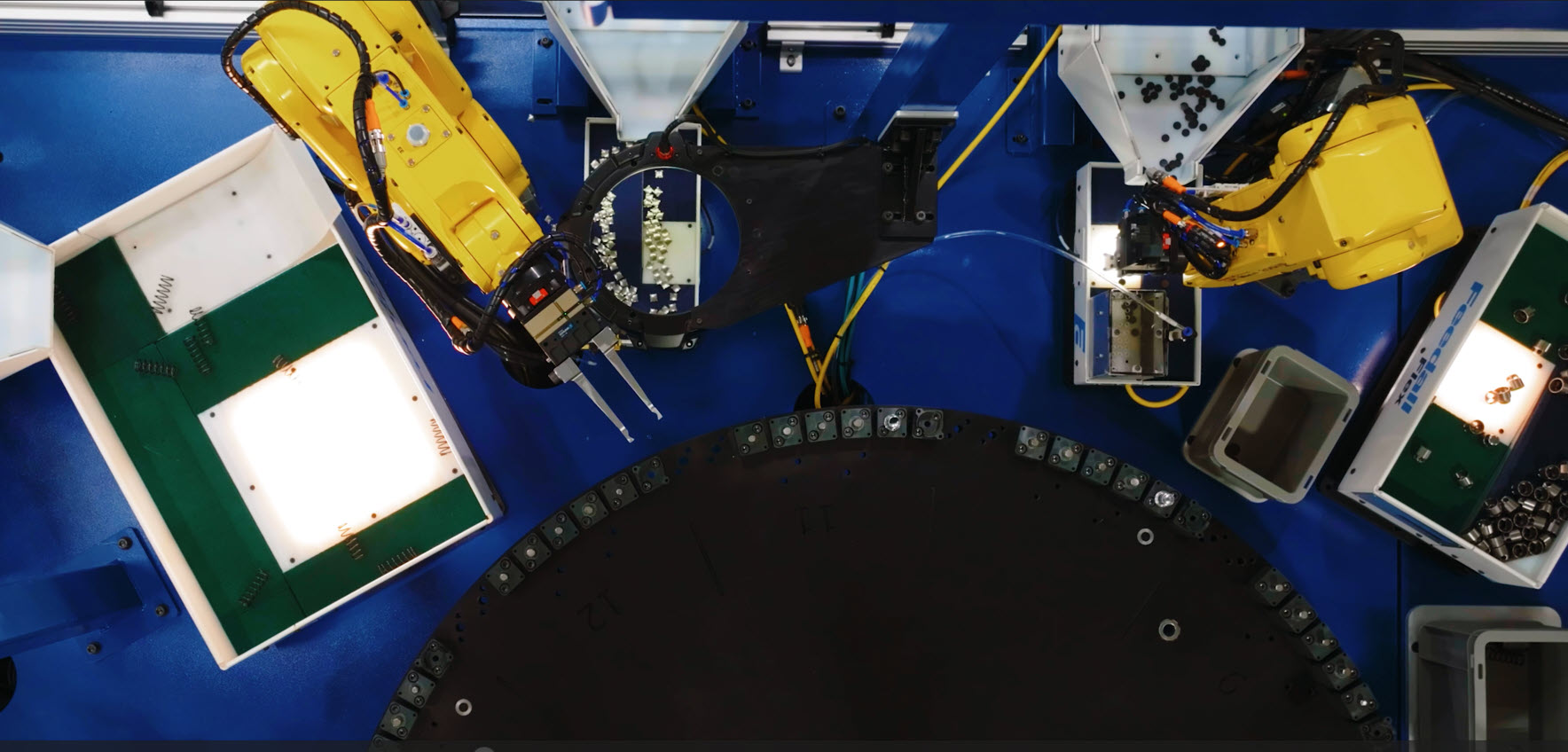
This shift has created the need for what Feedall refers to as Multi-Feed manufacturing—using a single automated feeding platform to reliably feed multiple part numbers without dedicated mechanical tooling.
Unlike traditional automation built around one specific component, Multi-Feed manufacturing emphasizes flexibility and adaptability.
The challenge is that many legacy feeding systems were never designed for this level of flexibility.
Why Traditional Feeding Systems Create Bottlenecks
Vibratory bowl feeders remain an excellent solution for many dedicated, high-volume applications.
When properly tooled, they can deliver exceptional throughput for years.
However, that performance comes with one significant tradeoff.
Every new component often requires:
- Dedicated bowl tooling
- New tracks
- Different escapements
- Mechanical adjustments
- Production testing
The feeder effectively becomes dedicated to a single part.
For manufacturers running the same product around the clock, this approach works extremely well.
For manufacturers producing dozens—or even hundreds—of different SKUs, those changeovers become increasingly expensive.
How Flex Feeding Reduces Changeover Time
Flex feeding approaches automation differently.
Instead of relying on dedicated mechanical tooling, flex feeders use programmable motion combined with machine vision to present randomly loaded parts in pickable orientations.
When changing products, operators typically:
- Load a new recipe
- Update vision parameters
- Verify robot pick locations
- Resume production
The feeder hardware remains exactly the same.
No bowl replacement.
No tooling changes.
No track modifications.
No lengthy mechanical adjustments.
This dramatically reduces changeover time while allowing a single feeder to support true Multi-Feed manufacturing.
More Uptime Means Higher Profitability
Reducing changeover time delivers benefits far beyond operator convenience.
Every minute saved during setup becomes additional productive machine time.
Manufacturers typically gain:
- Increased equipment utilization
- Higher Overall Equipment Effectiveness (OEE)
- Reduced labor costs
- Fewer setup errors
- Faster response to customer demand
- Better return on automation investments
Instead of automation sitting idle during product changes, manufacturers keep production moving.
Supporting Lean Manufacturing
Lean manufacturing focuses on eliminating waste.
Long changeovers introduce several forms of waste:
- Waiting
- Excess inventory
- Additional labor
- Lost production
- Inefficient scheduling
Reducing changeover time allows manufacturers to:
- Produce smaller batch sizes
- Reduce work-in-process inventory
- Respond faster to customer demand
- Improve scheduling flexibility
These improvements closely align with Single-Minute Exchange of Die (SMED) principles, where reducing setup time creates immediate gains in manufacturing efficiency.
Why Multi-Feed Manufacturing Is Becoming Essential
High-mix manufacturers rarely have the luxury of producing one part indefinitely.
Automotive suppliers.
Medical device manufacturers.
Electronics producers.
Industrial equipment companies.
Many process dozens—or even hundreds—of different components every month.
Rather than investing in dedicated feeding equipment for every product, Multi-Feed manufacturing allows a single flex feeder to automate numerous part families with only software recipe changes.
This flexibility becomes especially valuable when introducing new products, accommodating engineering revisions, or responding to changing customer demand.
Engineering Resources Matter Too
The true cost of changeovers extends beyond production downtime.
Engineering teams frequently spend significant time designing, modifying, and maintaining dedicated feeder tooling.
Every new component may require:
- New bowl tooling
- New tracks
- New escapements
- Mechanical redesign
- Validation testing
Flex feeding shifts much of this effort from hardware to software.
Recipes can be created, optimized, and refined without redesigning mechanical tooling for every new part.
That allows engineering teams to focus on innovation instead of maintenance.
Looking Beyond Initial Equipment Cost
When evaluating automated feeding systems, many purchasing decisions focus only on the purchase price.
A more complete evaluation should consider:
- Changeover downtime
- Engineering labor
- Tooling costs
- Maintenance requirements
- Future product introductions
- Production flexibility
Over the life of an automation system, reducing changeover time often produces savings that far exceed the original equipment investment.
The Future of Automated Feeding Systems
Flex feeding is not intended to replace every vibratory feeder.
Dedicated bowl feeders continue to excel in applications requiring maximum throughput of a single component over long production runs.
However, manufacturers operating in today’s high-mix environment increasingly value flexibility as much as speed.
The question is no longer:
“How fast can this feeder run?”
The better question is:
“How quickly can I run my next product?”
That shift is driving the adoption of Multi-Feed manufacturing throughout modern automation.
Final Thoughts
Reducing changeover time in automated feeding systems is one of the fastest ways manufacturers can improve productivity, increase equipment utilization, and remain competitive in today’s rapidly changing marketplace.
Flex feeding enables true Multi-Feed manufacturing, allowing a single automated feeding system to support multiple SKUs with minimal downtime, fewer mechanical changes, and greater operational flexibility.
For manufacturers focused on shorter production runs, increasing product variety, and faster response times, reducing changeover time is no longer simply an efficiency improvement—it’s a strategic advantage.
At Feedall, we believe automation should adapt to your production—not force your production to adapt to the automation.
Because in modern manufacturing, flexibility isn’t just another feature.
It’s the competitive advantage.