
Getting a Higher ROI with a Flexible Assembly Line for High-Mix Manufacturing
Focused Key Phrase: Flexible Assembly Line for High-Mix Manufacturing
Why Manufacturers Are Rethinking Traditional Assembly Lines
Manufacturing has changed dramatically over the past decade. Customers expect greater product customization, shorter lead times, and faster innovation cycles. Instead of producing one product in massive quantities, manufacturers are increasingly building dozens—or even hundreds—of product variations in smaller batch sizes.
The problem? Traditional dedicated assembly lines were never designed for this environment.
Many manufacturers continue investing in fixed automation that delivers excellent throughput on a single product but struggles when product mix changes. Every new SKU often requires new tooling, engineering changes, downtime, and operator training. As product variety grows, the return on investment (ROI) from dedicated automation begins to decline.
This is why manufacturers across automotive, medical, consumer products, electronics, and industrial equipment are investing in flexible assembly lines designed specifically for high-mix, low-volume (HMLV) production.
A properly designed flexible assembly system doesn’t just reduce changeover time—it can significantly improve ROI across the entire manufacturing operation.
What Is a Flexible Assembly Line?
A flexible assembly line uses modular automation that can quickly adapt to different products without requiring extensive mechanical changes.
Rather than designing automation around a single product, flexible systems use configurable technologies such as:
- Flex feeding systems
- Robotic assembly
- Vision-guided robotics
- Quick-change fixtures
- Intelligent conveyors
- Automated inspection
- Recipe-based machine controls
- Modular workstations
Instead of rebuilding the production line every time a new product is introduced, manufacturers simply select the appropriate production recipe, swap minimal tooling if necessary, and begin running the next product.
Where Traditional Automation Loses ROI
Dedicated automation often appears less expensive when evaluating a single product.
However, many manufacturers overlook the lifetime costs associated with supporting multiple products.
These hidden costs include:
- Engineering redesign for every new SKU
- New vibratory bowl feeders
- New escapements
- New fixtures
- Additional spare parts inventory
- Extended changeovers
- Production downtime
- Operator retraining
- Lower equipment utilization
As product variety increases, these costs compound quickly.
The result is expensive automation that sits idle while operators make mechanical adjustments.
How Flexible Assembly Improves ROI
1. One Line Produces Multiple Products
Instead of purchasing separate assembly lines for each product family, manufacturers can build multiple products on a single flexible platform.
Benefits include:
- Higher equipment utilization
- Lower capital investment
- Reduced factory footprint
- Easier scheduling
- Improved labor efficiency
The more products that share one line, the greater the ROI.
2. Faster Product Changeovers
One of the largest hidden costs in manufacturing is changeover time.
Traditional assembly systems may require:
- Manual adjustments
- Tool changes
- Feeder replacement
- Programming changes
- Quality verification
Flexible systems minimize these activities.
Many modern assembly lines can switch products in just a few minutes using stored production recipes and modular tooling.
Every minute saved is additional production capacity.
3. Lower Tooling Costs
Dedicated automation typically requires unique tooling for every product.
Flexible systems dramatically reduce tooling requirements by using:
- Universal grippers
- Vision guidance
- Flexible feeders
- Adjustable fixtures
- Servo positioning
Instead of purchasing new tooling with every engineering revision, manufacturers often reuse existing hardware.
4. Increased Overall Equipment Effectiveness (OEE)
High-mix manufacturers often experience lower OEE because production frequently stops for setup changes.
Flexible automation improves:
- Availability through reduced downtime
- Performance through optimized automation
- Quality through repeatable robotic processes
Improving OEE often delivers one of the highest financial returns of any automation investment.
5. Faster New Product Introduction (NPI)
Launching new products should not require building an entirely new assembly line.
Flexible manufacturing allows companies to:
- Validate prototypes faster
- Introduce engineering revisions quickly
- Launch pilot production
- Scale production as demand increases
This agility can become a significant competitive advantage.
Why Flexible Feeding Plays a Critical Role
Many manufacturers focus only on robots when designing flexible assembly.
However, the robot can only assemble parts that arrive in a consistent, repeatable orientation.
That makes part feeding one of the most important components of the entire assembly process.
Traditional vibratory bowl feeders often require:
- Dedicated tooling
- Custom bowls
- Mechanical tuning
- Long lead times
- New bowls for product revisions
Flexible feeding changes this equation.
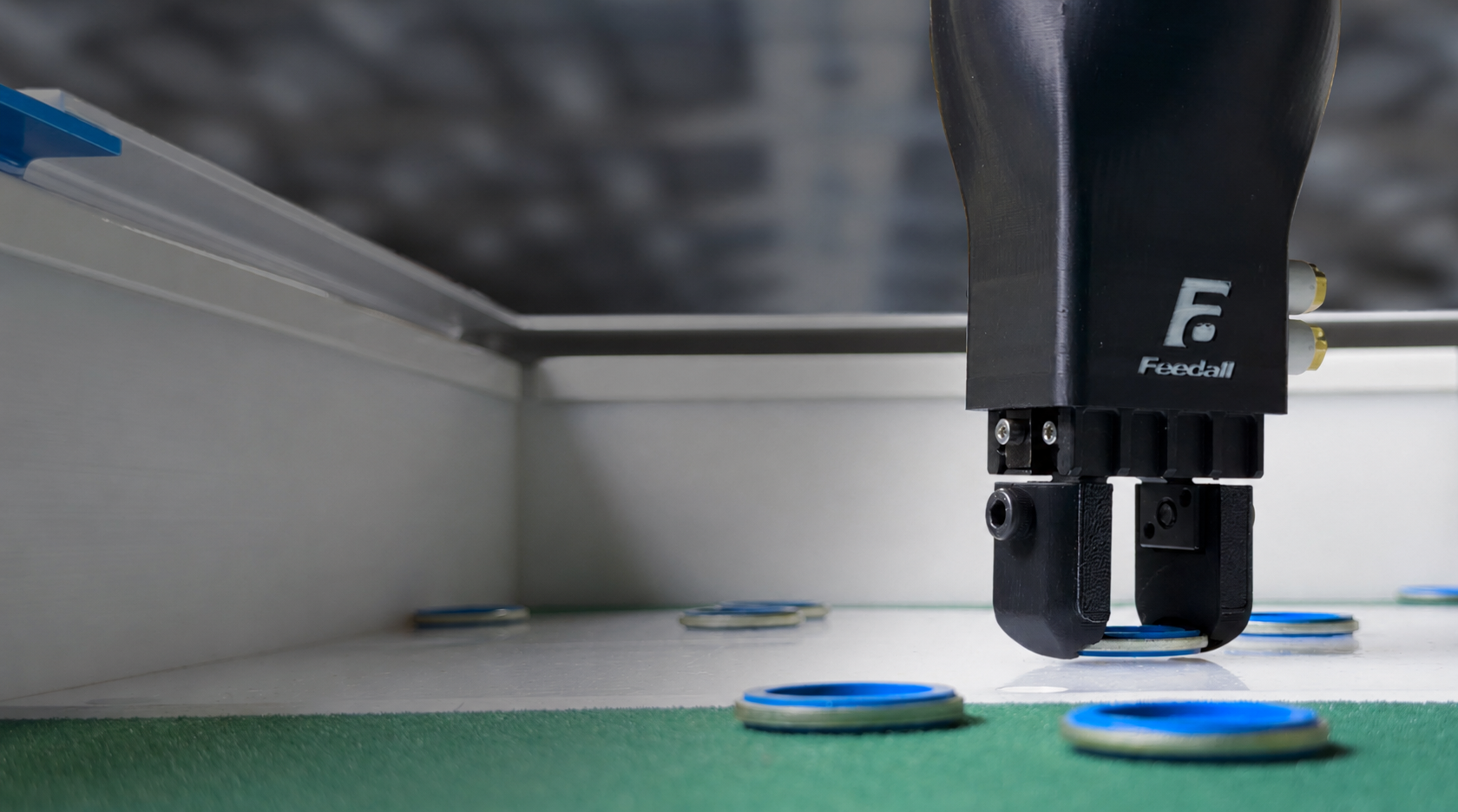
Using vision-guided flex feeders, manufacturers can often feed multiple product families using the same system with little or no mechanical change.
This supports true multi-feed manufacturing, allowing one production line to handle numerous SKUs while dramatically reducing tooling costs and changeover time.
For manufacturers transitioning to high-mix production, flexible feeding is often the first—and most impactful—step toward a flexible assembly line.
Industries Seeing the Greatest ROI
Flexible assembly delivers value across nearly every manufacturing sector, including:
Automotive
Vehicle platforms continue expanding while option packages multiply.
Flexible assembly allows manufacturers to build multiple variants without dedicated production lines.
Medical Devices
Medical manufacturers often produce dozens of similar products under strict quality requirements.
Flexible automation supports fast validation while maintaining traceability.
Electronics
Short product life cycles require automation that adapts quickly to new models.
Consumer Products
Seasonal demand and frequent product updates make flexible production especially valuable.
Industrial Equipment
OEMs increasingly offer customized products built from common assemblies.
Flexible assembly supports this strategy without increasing manufacturing complexity.
Questions to Ask Before Investing
Before purchasing new automation, manufacturers should ask:
- How many product variations will this line support?
- What is the expected product roadmap over the next five years?
- How long do changeovers currently take?
- How much tooling will future products require?
- Can existing automation be reused?
- What is the cost of downtime during product transitions?
These questions often reveal that flexibility—not maximum speed—is the true driver of long-term ROI.
The Future Belongs to Flexible Manufacturing
Manufacturing is moving toward greater customization, shorter product life cycles, and more frequent engineering changes.
Companies that continue investing solely in dedicated automation may find themselves rebuilding production systems every few years.
Flexible assembly lines offer a different approach.
By combining robotics, vision systems, modular automation, and flexible feeding technology, manufacturers can:
- Increase equipment utilization
- Reduce changeover time
- Launch products faster
- Lower tooling costs
- Improve overall ROI
- Future-proof manufacturing investments
For manufacturers embracing Industry 4.0 and smart manufacturing, flexibility is no longer a luxury—it is becoming a competitive necessity.
Why Feedall Builds Automation for High-Mix Manufacturing
At Feedall Automation, we help manufacturers design assembly systems that are built for today’s production environment—not yesterday’s.
Our solutions combine:
- Flexible feeding systems
- Vision-guided robotics
- Robotic assembly
- Bin picking
- Custom automation
- Material handling
- Part orientation
- Intelligent integration
Whether you’re replacing dedicated vibratory systems or designing an entirely new assembly line, our engineers help you maximize ROI while creating automation that can adapt as your business grows.
If your production mix keeps changing, your automation should be able to change with it.