
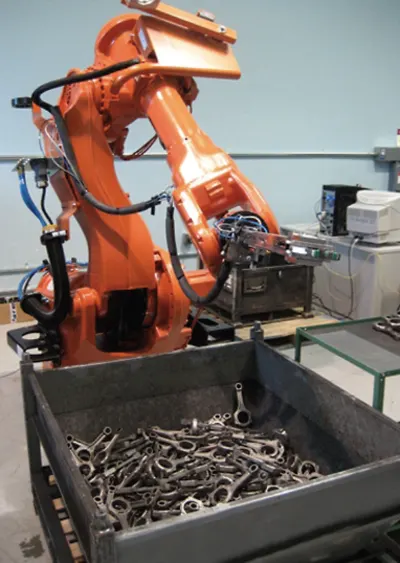
How Flexible Feeding Is Now Helping Robotic Bin Picking
For years, robotic bin picking and flexible feeding were pitched as competing answers to the same question: how do you get a robot to pick parts that arrive in a jumbled pile? Bin picking reached into the pile with 3D vision. Flex feeding spread the pile out so a simpler camera could see it. Today, the smartest automation cells are not choosing between them. They are using flexible feeding to fix the exact problems that make robotic bin picking slow, unpredictable, and hard to justify.
If you have read our earlier posts on when robotic bin picking makes sense and how bin picking software works, this is the next step: what happens when you stop asking one technology to do everything.
Where Robotic Bin Picking Gets Stuck
Robotic bin picking is impressive when it works. A 3D camera scans a tote, software matches what it sees against a part model, and the robot plans a collision-free path to grab a part. But anyone who has run a bin picking cell on a production floor knows where it struggles.
The last parts are the hardest. Well-tuned systems pull most parts quickly, then slow down on the stragglers wedged in corners, tangled together, or pinned against the bin wall. That tail end eats cycle time or needs a person to clear it.
The pick is rarely the final orientation. A robot grabbing a part out of a pile takes whatever grasp it can get. That grasp is often not the orientation the next station needs, so the cell adds a regrip stand, a second robot move, or both.
Every pick starts with a scan and a plan. Scanning a deep, cluttered bin and calculating a safe path takes time on every cycle. For many applications, that adds up to a cycle time the downstream process cannot wait for.
The vision stack is complex. 3D cameras, part models, grasp tuning, and collision checking all have to be set up and maintained by someone who understands them.
What Flexible Feeding Brings to the Cell
A flexible feeder takes bulk parts, spreads them across a flat platform, and uses vibration to separate and flip them. A 2D camera mounted above sees parts lying flat and apart, so the robot gets a clean, predictable pick every time. Parts that land the wrong way up are simply shaken again until they present correctly.
That is the opposite of the bin picking problem. Instead of asking vision to make sense of chaos, flex feeding removes the chaos before the camera looks. The Feedall Flex line is built around this idea, with platforms designed for part separation and presentation to standard 2D cameras.
The result is simpler vision, faster cycles, and near-complete picking, because no part is ever stuck at the bottom of a pile.
Three Ways Flex Feeding and Bin Picking Work Together
1. Bin picking as the bulk loader, flex feeding as the presenter. A 3D-guided robot no longer has to make a perfect pick from the tote. It only has to grab a part, or a small handful, and drop it on the flex feeder. Those “good enough” picks are much faster and more forgiving than precision picks. The flex feeder then separates and orients the parts, and a second robot, or the same one, makes a fast 2D pick in the right orientation for assembly. This two-stage approach takes the hardest job off the 3D vision system.
2. Flex feeding as the safety net for stragglers. When a bin picking cell reaches the tangled, cornered parts at the bottom of a tote, it can dump the remainder onto a flex feeder instead of fighting for each one. The feeder untangles and separates them, and production keeps moving without an operator stepping in. This directly targets the tail-end problem that drags down bin picking pick rates.
3. A metered hopper or conveyor instead of a deep bin. For many parts, the most reliable answer is to skip the deep bin entirely. A charging conveyor or bulk hopper meters parts onto the flex feeder at a controlled rate, and the robot picks from the platform. You keep the flexibility of bulk loading without the vision complexity of random bin picking.
Robotic Bin Picking vs. Flex Feeding vs. the Hybrid Cell
| Robotic bin picking alone | Flex feeding alone | Bin picking + flex feeding | |
|---|---|---|---|
| Part input | Deep bins and totes | Bulk parts from a hopper or conveyor | Deep bins and totes |
| Vision | 3D, complex setup | 2D, simpler setup | 3D for the coarse pick, 2D for the final pick |
| Final part orientation | Whatever the grasp allows; often needs regrip | Presented flat and correctly oriented | Presented flat and correctly oriented |
| Bin clearing | Slows down on the last parts | Not applicable | Leftovers dumped to feeder and recovered |
| Cycle time | Slower (scan and plan each pick) | Fast | Fast at the final pick; bulk pick runs in parallel |
| Best for | Larger parts that must come from deep totes | Small to mid-size parts, high mix | Parts that arrive in totes but need precise, fast presentation |
Is a Hybrid Cell Right for Your Application?
- Parts arrive in bulk totes or bins that you cannot cost-effectively pre-sort
- The next station needs parts in a specific orientation, not just picked
- Your current bin picking cell stalls or needs an operator to clear the last parts
- Cycle time is tighter than a scan-and-plan pick can deliver on its own
- Parts are small enough to lie flat and separate on a flex feeder platform
- You run several part numbers and want changeovers handled in software
If you checked three or more, pairing flexible feeding with robotic bin picking is worth a serious look. If parts are large, heavy, or must stay in their tote, standalone bin picking may still be the better fit. If parts arrive loose and small, a flex feeder alone, or even a vibratory bowl feeder, may be all you need.
How Feedall Builds These Cells
Feedall is one of the few automation partners that builds both sides of this equation. On the bin picking side, Feedall is the exclusive US distributor of Moonflower 3D bin picking software from Euclid Labs. On the feeding side, the Feedall Flex line handles part separation and presentation, backed by more than 75 years of part feeding engineering.
That means the recommendation comes from your parts, not a product catalog. Feedall president Nick Barron has talked about this shift directly, including on an Automation World podcast with SICK on how simpler 2D vision is changing industrial part picking.
The Bottom Line
Robotic bin picking is not going away, and it does not need to. What is changing is the job it is asked to do. By letting flexible feeding handle separation, orientation, and the stubborn parts at the bottom of the bin, manufacturers get the reach of 3D bin picking with the speed and reliability of flex feeding.
Send Feedall your parts for a free application review and find out whether robotic bin picking, flex feeding, or a hybrid cell is the right fit for your line.
FAQ
Can flexible feeding replace robotic bin picking? Sometimes. For small to mid-size parts that can be bulk-loaded from a hopper or conveyor, a flex feeder alone often picks faster and more reliably. For larger parts that must come from deep totes, bin picking still does the bulk work, and flex feeding improves the final pick.
What is a hybrid bin picking and flex feeding cell? A 3D-guided robot makes a quick, coarse pick from the bin and drops parts onto a flex feeder. The feeder separates and orients them, and a robot makes a fast 2D-guided pick in the exact orientation the next station needs.
Does adding a flex feeder slow down bin picking? Usually the opposite. The bulk pick no longer has to be precise, so it runs faster, and the final 2D pick from the feeder is quick. The two stages can also run in parallel.
How does flex feeding help with the last parts in a bin? Instead of fighting for tangled or cornered parts, the cell can dump the remainder onto the flex feeder. Vibration separates them so the robot can pick them normally, reducing the need for an operator to clear the bin.
What camera does a flex feeder need compared with bin picking? Flex feeders typically use a standard 2D camera, since parts lie flat and separated. Random bin picking needs a 3D camera and more complex software to locate parts in a pile.
Continue Learning
- How Bin Picking Software Works — last week’s post on the vision, matching, and path-planning stack behind a bin picking cell.
- What to Look for When Choosing a Bin Picking System — the Sept 29 buyer’s guide.
- When Should You Use Robotic Bin Picking? — the Sept 22 post on when bin picking pays off and when it doesn’t.
- Why Flexible Parts Feeding Is Replacing Vibratory Bowl Feeders — the July 28 Flexible Feeding pillar post.