
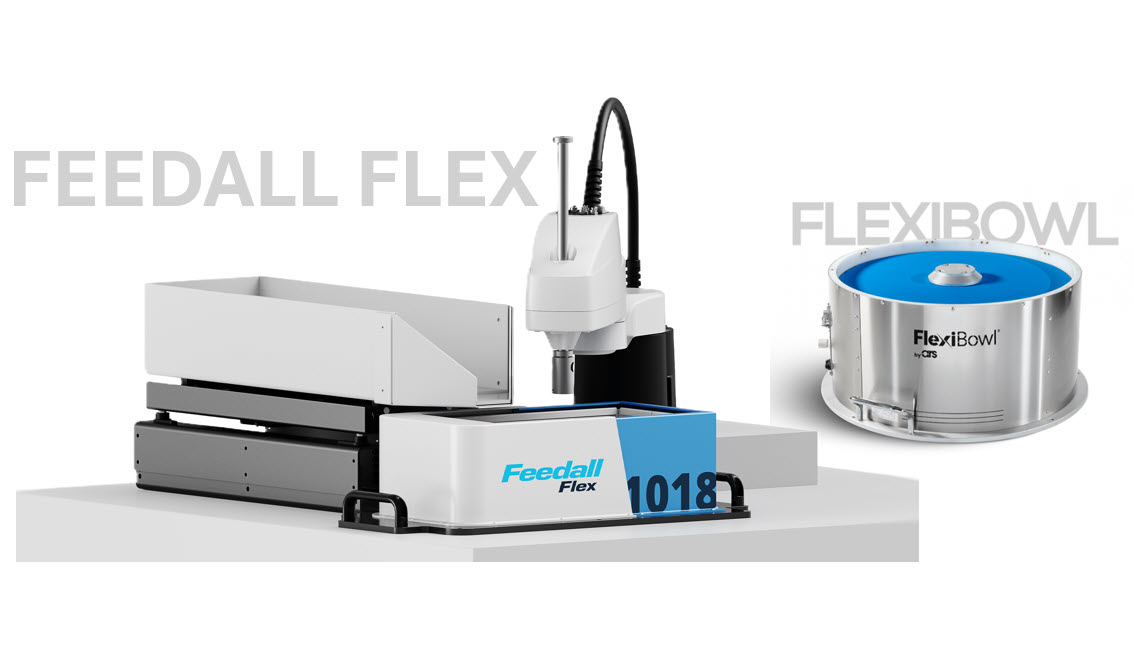
Feedall Flex Feeder vs. FlexiBowl: The Capabilities That Actually Matter
When manufacturers compare flexible feeding systems, two names that may come up are Feedall Flex Feeders and FlexiBowl®.
Both technologies are designed around the same fundamental manufacturing challenge: how do you automatically feed a wide variety of parts to a robot without building dedicated mechanical tooling for every component?
But comparing flexible feeders shouldn’t simply be a comparison of specifications or operating principles.
The better question is:
What capabilities actually matter for your application?
Part size, part weight, usable picking area, orientation requirements, changeovers, vision integration, and the ability to expand the system as production requirements change can all have a major impact on the final automation cell.
Here are the areas manufacturers and automation integrators should evaluate when comparing Feedall Flex Feeders with FlexiBowl.
1. Start With the Parts You Actually Need to Feed
Flexible feeding is valuable because one system can accommodate multiple components without requiring a dedicated feeder for every part.
However, “flexible” doesn’t mean every feeder handles every part equally well.
The physical range of the feeder matters.
Feedall offers multiple Flex Feeder sizes designed to cover applications ranging from very small components to substantially larger and heavier industrial parts.
Across the current Feedall Flex Feeder family, applications can range from parts as small as approximately 2 mm up to 350 mm, depending on the feeder selected.
At the large end of the range, Feedall’s largest platform is rated for individual parts weighing up to approximately 1,200 grams (2.64 lb) and a maximum feeder payload of approximately 20 kg (44.1 lb).
FlexiBowl also offers multiple feeder sizes. Its current published product range covers components up to approximately 300 mm, with its largest published recommended individual component weight reaching approximately 300 grams.
For small components, either technology may potentially fit the application.
As parts become larger, heavier, or more difficult to manipulate, however, feeder capability becomes increasingly important.
Capability that matters:
Don’t ask only, “Can this feeder handle my smallest part?”
Ask:
“Can this feeder handle the complete family of parts I expect this automation cell to run?”
That question becomes particularly important when designing equipment expected to remain productive for many years.
2. Part Weight Can Be Just as Important as Part Size
Two parts with identical outside dimensions can behave completely differently in a flexible feeder.
A lightweight molded plastic component and a machined steel component may occupy roughly the same space but require very different feeding energy and part-control strategies.
This is an area where manufacturers handling heavier industrial components should look carefully at the specifications.
Feedall’s Flex Feeder family scales from small-part applications through feeders capable of handling individual components weighing approximately:
- 100 g on smaller systems
- 250 g on mid-sized systems
- 600 g on larger systems
- 1,200 g on the largest platform
That broader weight capability can open flexible feeding to applications involving machined components, stampings, castings, forgings, automotive components, and other parts that may fall outside the practical range of smaller flexible feeders.
FlexiBowl’s current published range extends from very small components through systems rated for individual parts up to approximately 300 g.
Neither specification automatically makes one feeder better.
It simply means the application envelope is different.
And application envelope matters more than brand name.
3. Picking Area Matters More Than Many Buyers Realize
One of the most overlooked specifications when evaluating a flexible feeder is the usable picking area.
The purpose of a flex feeder isn’t merely to move parts.
It needs to create enough separated and correctly presented parts for the vision system to identify and the robot to pick.
Feedall Flex Feeders are designed around large picking surfaces.
Depending on model, current Feedall systems provide pickable areas ranging from approximately 72 square inches to 1,260 square inches.
Why does that matter?
Because a larger usable picking area can provide more opportunities for parts to separate and become pickable.
This becomes especially important when dealing with:
- Large components
- Parts that overlap easily
- Components with difficult geometries
- Heavy components
- Parts requiring specific face orientation
- Applications requiring several available robot picks
A feeder may technically accommodate a component while still providing too little useful area to consistently generate enough pickable parts.
Capability that matters:
When evaluating a feeder, don’t look only at its outside dimensions.
Look at how much usable space the system gives the vision system and robot to work with.
4. How the Feeder Controls the Part Matters
Feedall Flex Feeders and FlexiBowl use different mechanical approaches to accomplish the same basic objective: separating and presenting randomly loaded components for vision-guided robotic picking.
FlexiBowl uses a rotating disc combined with a programmable impulse or flipping mechanism. Parts move around the circular feeding surface while the system separates and redistributes them for vision inspection and robotic picking.
Feedall takes a different approach.
A Feedall Flex Feeder uses a controlled vibrating surface to recirculate, separate, and redistribute components across the picking zone. The feeder cycles so the vision system can identify pickable components and provide their locations to the robot.
That difference becomes important when dealing with components that are difficult to control.
Feedall’s system is specifically designed to provide part separation and orientation across the feeding surface, including applications where face selection and controlled presentation are important.
The question therefore isn’t simply whether a feeder can move the part.
It is:
Can the feeder repeatedly create the orientation and separation conditions the robot needs?
5. Vision and Robotics Are Part of the Feeding System
Modern flexible feeding isn’t really one machine.
It is a coordinated system involving:
Bulk storage → part presentation → vision → robot → downstream process
Both Feedall Flex Feeders and FlexiBowl are designed to operate with robotic and machine-vision systems.
FlexiBowl states that its platform can integrate with different vision systems and robots, and it also offers its own FlexiVision solution and communication plug-ins for a variety of industrial robots and PLCs.
Feedall Flex Feeders similarly use vision-guided robotic picking, with the feeder creating separated parts that can be located by the vision system and retrieved by the robot.
For the manufacturer, the important question isn’t simply whether a camera can be mounted above the feeder.
The important questions are:
- How easy is the system to integrate?
- How predictable is the feeding cycle?
- How easily can new components be taught?
- How much programming is required?
- How quickly can an integrator commission the complete cell?
- How reliably can the system create pickable parts?
The feeder, vision system, robot, and controls should ultimately behave as one automation system.
6. Changeover Capability Is Where Flexible Feeding Creates ROI
The strongest argument for flexible feeding isn’t necessarily feeder speed.
It’s production flexibility.
Traditional dedicated feeding equipment can be extremely effective when one component will run continuously for years.
But many manufacturers no longer operate that way.
Production increasingly involves:
- Higher product mix
- Shorter production runs
- More product variants
- More frequent changeovers
- Faster product introductions
- Automation cells expected to run future products
Both Feedall Flex Feeders and FlexiBowl address this problem by reducing reliance on dedicated mechanical tooling.
Instead of replacing an entire feeder when the component changes, the automation system can often be reconfigured through feeder parameters, vision recipes, robot programs, and appropriate end-of-arm tooling.
This can dramatically change the economics of automation.
Instead of asking:
“What does this feeder cost?”
Manufacturers should ask:
“How many products can this automation cell run over its useful life?”
That is often where the real ROI of flexible feeding is found.
7. Future Part Families Should Influence Today’s Feeder Selection
One common mistake is sizing a flexible feeder around only the part currently being automated.
That can undermine one of the biggest advantages of flexible automation.
Imagine a manufacturer currently running components between 30 and 60 mm.
A smaller feeder might satisfy today’s requirement.
But what happens when a 100 mm component is introduced next year?
Or a heavier steel version of the existing component?
Or an entirely new product family?
If the feeder doesn’t have enough size, payload, picking area, or part-control capability, the manufacturer may need another feeding system.
The better approach is to define a reasonable future operating envelope.
Consider:
Current Parts + Known Future Parts + Reasonable Future Part Families
Then select the feeding platform accordingly.
Flexible automation should provide room for manufacturing requirements to change.
Feedall Flex Feeder vs. FlexiBowl: A Practical Comparison
| Capability | Feedall Flex Feeder | FlexiBowl |
|---|---|---|
| Feeding concept | Controlled vibrating feeding surface | Rotating disc with programmable impulse/flip |
| Published part-size range | Approximately 2–350 mm across models | Approximately 1–300 mm across models |
| Published maximum individual part weight | Up to approximately 1,200 g | Up to approximately 300 g |
| Published maximum feeder payload | Up to approximately 20 kg | Up to approximately 7 kg |
| Vision-guided robotic picking | Yes | Yes |
| Multiple feeder sizes | Yes | Yes |
| Handles varied materials/surfaces | Yes | Yes |
| Quick product changeover strategy | Yes | Yes |
| Large/heavy industrial part capability | Major strength | More limited published envelope |
| Multi-part capabilities | Available on appropriate configurations | Available on selected models |
Specifications are important, but they should never replace testing with actual production components.
So Which Flexible Feeder Is Better?
There isn’t one answer for every application.
FlexiBowl is an established flexible feeding technology with a broad installed base and a strong range of solutions for small and medium-sized components.
Feedall Flex Feeders approach the same automation problem differently and offer an especially compelling capability envelope when applications involve larger components, heavier parts, large picking areas, demanding orientation requirements, or a broad family of industrial components.
The right comparison therefore isn’t:
Feedall vs. FlexiBowl — which brand wins?
It’s:
Which system gives your automation cell the capabilities it actually needs?
That requires evaluating the real parts, production rates, required orientations, robot strategy, changeover frequency, and future product families.
Test the Parts Before You Choose the Feeder
The most reliable way to select a flexible feeding system is to test it using actual production parts.
Feedall can evaluate components and help determine the appropriate feeder size, feeding strategy, vision approach, and robotic integration requirements for the application.
If you’re evaluating a FlexiBowl, Feedall Flex Feeder, traditional bowl feeder, or robotic bin-picking system, don’t start with the technology.
Start with the parts and the production requirement.
Then choose the feeding technology that gives your automation system the greatest capability today—and the flexibility to handle what comes next.
Continue Learning
Explore these related Feedall resources:
- Flexible Feeding Systems: The Modern Standard for Robotic Automation
- How to Choose the Right Flex Feeder
- Why Flexible Parts Feeding Is Replacing Vibratory Bowl Feeders
- Flexible Assembly: Getting Higher ROI in High-Mix Manufacturing
- Bowl Feeder vs. Flexible Feeder: Which Is Better for Modern Automation?
- Vision-Guided Feeding Systems Explained
- Bin Picking vs. Flexible Feeding: Which Is More Efficient?