
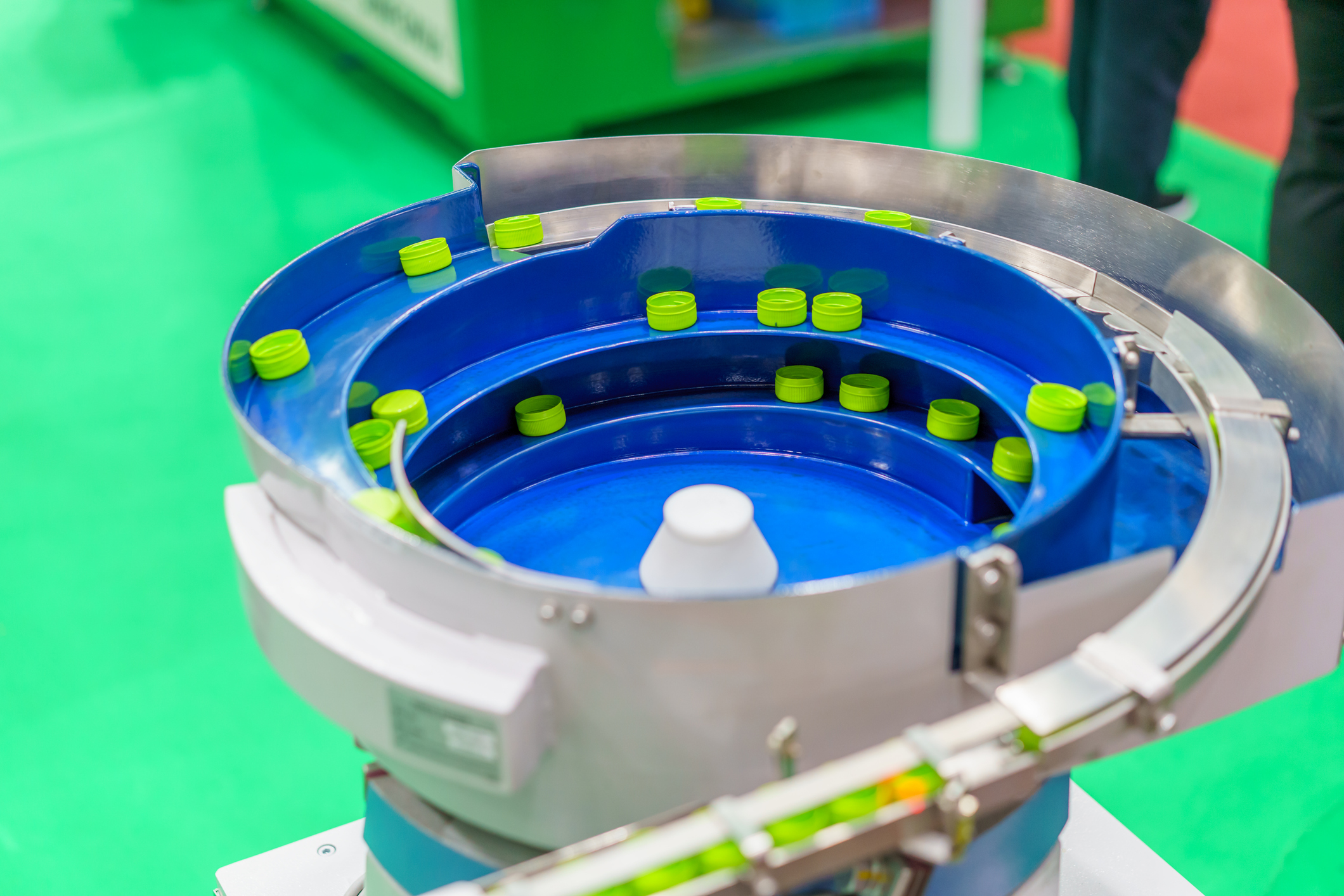
When a Vibratory Bowl Feeder Is Still the Best Choice
Flexible feeding, robotic vision, and bin picking have changed the way manufacturers think about part feeding. At Feedall Automation, we have invested heavily in these technologies because they solve applications that were historically difficult—or sometimes impractical—to automate.
But that doesn’t mean the vibratory bowl feeder is obsolete.
Far from it.
For the right application, a well-designed vibratory bowl feeder remains one of the simplest, fastest, and most cost-effective ways to orient and deliver parts into an automated manufacturing process.
The key is understanding when to use one—and when another feeding technology makes more sense.
The Goal Isn’t to Sell a Technology. It’s to Feed the Part.
At Feedall, we manufacture both conventional part feeding systems and flexible robotic feeding systems. That gives us a somewhat different perspective on the debate between vibratory and flexible feeding.
We don’t believe one technology should replace the other.
Instead, we start with the application:
What is the most reliable and economical way to get this particular part into the required orientation, at the required rate, for the required production environment?
Sometimes the answer is a vision-guided Flex Feeder.
Sometimes it’s robotic bin picking.
And sometimes the best answer is still a vibratory bowl feeder.
Here are some of the situations where vibratory feeding continues to excel.
1. You’re Running One Part—or a Small Number of Parts—for a Long Time
One of the biggest advantages of flexible feeding is its ability to accommodate multiple part geometries with minimal mechanical changeover.
But what if you don’t need that flexibility?
If a production line is expected to run the same component for years, dedicated tooling can be an advantage rather than a disadvantage.
A properly engineered vibratory bowl can continuously:
- Singulate parts
- Orient them mechanically
- Reject incorrectly oriented parts
- Recirculate those parts
- Deliver correctly oriented components to the next process
Once the system is dialed in, this can happen continuously with very little intervention.
For high-volume, dedicated production, that simplicity is difficult to beat.
2. You Need Very High Feed Rates
Cycle rate is another area where conventional vibratory feeding can shine.
Flexible feeding typically requires several steps. Parts must be dispersed onto a feeding surface, identified by a vision system, picked by a robot, and transferred to the next operation.
Each step takes time.
A vibratory bowl feeder operates differently. Properly oriented parts can continuously flow from the bowl into an inline track, conveyor, escapement, or downstream machine.
For applications requiring a high and continuous parts-per-minute rate, a properly designed vibratory feeding system can therefore be an excellent solution.
This is particularly attractive when the part geometry naturally lends itself to mechanical orientation.
3. The Part Has an Easy-to-Identify Mechanical Orientation
Some parts are simply made for bowl feeding.
A component might have:
- A major difference in diameter from one end to another
- A flange or shoulder
- A distinct center of gravity
- An obvious head-and-tail relationship
- A geometric feature that makes mechanical orientation straightforward
When those characteristics can be reliably identified through tooling, there may be little reason to introduce a camera and robot simply to determine orientation.
Good feeder engineering uses the natural geometry and physics of the part to accomplish as much of the work as possible.
If we can reliably orient a part mechanically, a vibratory bowl feeder may provide a remarkably simple solution.
4. Product Changeovers Are Infrequent
One of the most important questions we ask customers is:
How often will this part change?
If a manufacturer expects frequent product changes, flexible feeding becomes increasingly attractive because recipes and vision programs can replace significant amounts of dedicated mechanical tooling.
But consider a machine that produces the same component every day and is expected to continue doing so for the next five or ten years.
The economics change considerably.
Investing in dedicated tooling once may make more sense than paying for flexibility the application doesn’t actually need.
The expected product lifecycle should therefore be an important part of every feeding technology decision.
5. You Want a Simple Automation Architecture
There is real value in simplicity.
A conventional vibratory feeding system can often orient and present parts without requiring:
- A vision system
- A robot
- Robot programming
- Vision recipes
- Additional controls integration
Fewer components can mean fewer things for the plant’s maintenance team to troubleshoot.
For certain production environments, particularly where a machine is expected to run one product continuously, that simplicity can be a significant advantage.
6. Cost Is More Important Than Future Flexibility
Automation shouldn’t include technology simply because the technology exists.
It needs to generate a return.
If a dedicated vibratory bowl can accomplish the required orientation and feed rate reliably, adding vision and robotics may increase the initial investment without generating enough additional value.
The equation changes when flexibility has economic value.
If the customer expects new products, shorter product lifecycles, frequent changeovers, or multiple SKUs on the same machine, investing more initially in flexible automation can reduce future tooling and reconfiguration costs.
But for a stable, high-volume application?
A vibratory bowl feeder may deliver the better ROI.
When Should You Consider Flexible Feeding Instead?
There is another side to the decision.
As parts become more complex and production becomes more variable, traditional bowl feeding can require increasingly complicated tooling.
That’s when we start asking whether the application has crossed the line where flexibility becomes more valuable than dedicated mechanical orientation.
A Feedall Flex Feeder should generally receive stronger consideration when:
- Multiple different parts must run through the same system
- Product changeovers occur frequently
- New part variants are expected
- Mechanical orientation would require complex tooling
- Parts are delicate or susceptible to damage
- A robot is already part of the automation cell
- Vision inspection can provide additional process value
- Future flexibility is strategically important
This is why we don’t believe the future of part feeding is simply flexible feeding replacing vibratory feeding.
The future is having more technologies available and applying each one where it makes the most sense.
Vibratory Bowl Feeder vs. Flex Feeder: A Simple Starting Point
| Application Characteristic | Vibratory Bowl Feeder | Flex Feeder |
|---|---|---|
| High-volume dedicated part | Excellent | Good |
| Very high feed rate | Excellent | Application dependent |
| Simple part geometry | Excellent | Good |
| Multiple part geometries | Limited | Excellent |
| Frequent changeovers | Limited | Excellent |
| Future product changes | Limited | Excellent |
| Minimal controls complexity | Excellent | Moderate |
| Difficult mechanical orientation | Application dependent | Excellent |
| Robot already in the cell | Good | Excellent |
| Long-term dedicated production | Excellent | Good |
There isn’t a universal winner.
The application determines the winner.
Feedall Has Been Building Vibratory Feeding Systems for Decades
Part feeding isn’t new to Feedall.
Our experience in feeding and material handling goes back decades, long before vision-guided robots and flexible feeding became practical alternatives.
That experience matters because successful feeding requires more than selecting a piece of equipment.
It requires understanding:
How does the part behave?
How does it move? How does it nest? Where is its center of gravity? Which features can be used for orientation? What rate does the downstream machine actually require? How much accumulation is needed? What happens when production stops and restarts?
Those same fundamentals apply whether we’re designing a vibratory feeder, conveyor, Flex Feeder, or robotic feeding system.
The Best Feeding System Is the One Designed Around the Application
Manufacturing technology has a tendency to move toward extremes.
A new technology arrives and suddenly everything that came before it is considered obsolete.
We don’t see part feeding that way.
Flexible feeding has opened an entirely new range of automation possibilities. Vision and robotics allow manufacturers to handle part variation that would have required extensive mechanical tooling in the past.
But vibratory bowl feeders remain an outstanding technology for the applications they are good at.
If you have:
High volume + stable production + a mechanically orientable part + limited changeovers, start by looking seriously at a vibratory bowl feeder.
If you have:
High mix + frequent changeovers + difficult orientation + future part variation, flexible feeding deserves serious consideration.
And sometimes the best automation system uses both technologies together.
That’s why the first question shouldn’t be:
“Do I need a vibratory bowl feeder or a Flex Feeder?”
It should be:
“What is the best way to feed my part?”
That’s the question Feedall has been helping manufacturers answer for decades.
Continue Learning
Explore more Feedall resources on:
- Vibratory Bowl Feeders
- Flexible Parts Feeding
- Feedall Flex Feeders
- Part Feeding Automation
- Vibratory Conveyors
- Robotic Bin Picking
Have a part you’re trying to feed? Send Feedall a part drawing, photo, or sample along with your required production rate. Our team can help determine whether a vibratory bowl feeder, Flex Feeder, bin picking system, or another feeding technology is the best fit for your application.