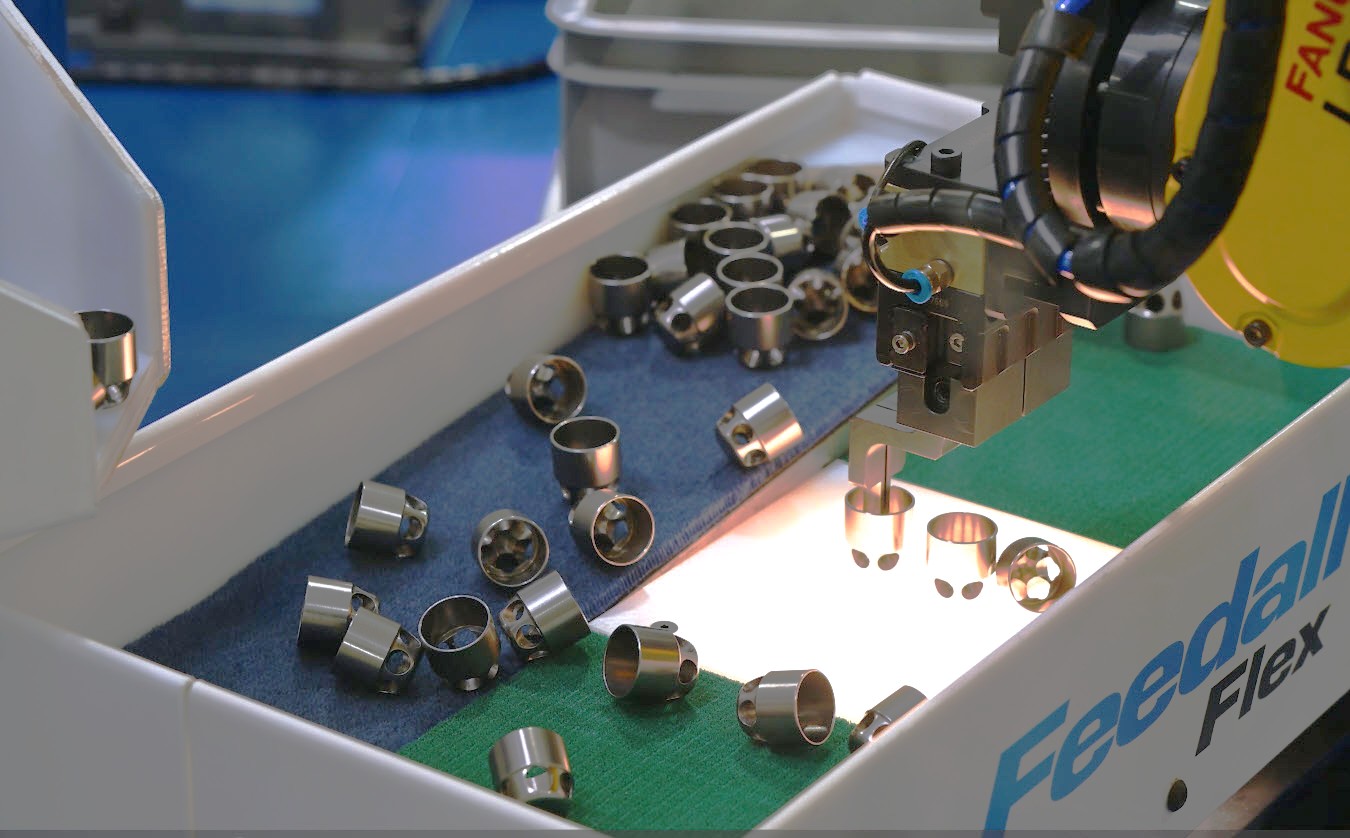
Spec sheets tell you what a flex feeder should do. Running parts tells you what it actually does. That is why the best way to understand the Feedall Flex Feeder is to look at the jobs it is already doing: presenting hose fittings to an assembly robot, feeding blanks to a CNC machine, separating rings that like to nest, and building complete kits with no direct production labor.
Below are six Feedall Flex applications, what made each one hard, and how flexible feeding solved it. Each one links to video of the equipment running in our video library, so you can see the parts move for yourself.
Key Takeaways
- The Feedall Flex Feeder comes in four sizes (612, 1018, 1624 and 3042) for vision-guided robot and cobot cells.
- Flex feeding works best when you run many part numbers, change over often or handle parts that tangle, nest or scratch.
- Integrated hoppers, backlighting, flipping fixtures and true recirculating part flow are what turn a good pick rate into a reliable one.
- In one Feedall flexible kitting system, the customer reached at least 99% kitting accuracy with about 0.5 operator per shift.
What Is the Feedall Flex Feeder?
The Feedall Flex Feeder is a flexible parts feeding system that spreads bulk parts across a picking surface so a vision-guided robot or cobot can locate and pick them. Instead of tooling a dedicated bowl for each part, the feeder uses controlled vibration to separate, flip and recirculate parts until the robot finds one it can pick. Changing to a new part is mostly a recipe change, not a retooling project.
The line includes four models. The table-top Flex 612 has a 6 by 12 inch picking zone for small parts, and the Flex 1018, Flex 1624 and Flex 3042 scale up for larger parts and higher volumes. Options include integrated vibratory hoppers with a sensor that meters the exact number of parts delivered, backlights for clean part silhouettes, an Airbox for separating tangled parts and gentle part-flipping fixtures.
1. Hose Fitting Assembly Cell
The challenge: Hose fitting assembly involves several small components with different shapes, and each fitting family has its own set. A dedicated bowl feeder for every component would take up floor space and lock the cell into one product.
The flex feeding solution: In this cell, Feedall Flex Feeders present fitting components to a robot that assembles them. Because every part is located by vision, the same feeder can run different components by switching recipes, and the hopper keeps the picking surface supplied without overfilling it.
Why it matters: High-mix assembly is where flex feeding earns its keep. One feeder per station replaces a wall of dedicated bowls, and new fitting variants can be added without new tooling. Watch the hose fitting assembly cell.
2. CNC Machine Tending
The challenge: A CNC machine is only productive while it is cutting. When an operator has to load blanks by hand, spindle time is lost to breaks, shift changes and other tasks on the floor.
The flex feeding solution: A Feedall Flex Feeder holds a supply of blanks and presents them to a robot that loads the machine. When the shop changes jobs, it changes the vision recipe and, if needed, the gripper, rather than building a new fixture or magazine.
Why it matters: Flex-fed machine tending suits job shops that run many short batches. The feeder handles the part-to-part variation that rigid loaders struggle with. Watch the CNC machine tending short.
3. Picking Rings That Nest and Overlap
The challenge: Rings, washers and similar flat round parts tend to stack, nest and overlap. A robot cannot pick a ring it cannot see clearly, and two stacked rings look like one to a camera from above.
The flex feeding solution: The Feedall Flex Feeder uses vibration to break up stacks and spread rings across the surface. A backlight gives the vision system a sharp silhouette, so it can tell a single ring from a pair and send the robot only to clean picks. Rings that are not pickable recirculate and get another chance.
Why it matters: Separation is the difference between a demo and a production cell. Watch the Feedall Flex Feeder picking rings.
4. Soft, Quiet Feeding for Cam Lifters
The challenge: Cam lifters (lifters) are precision engine components with finished surfaces. Aggressive feeding can nick or mark them, and loud feeders add to plant noise.
The flex feeding solution: The Feedall Flex Feeder is designed for smooth, quiet part handling. Low-amplitude motion moves the lifters gently across the picking surface, and the robot picks them without metal-on-metal tumbling in a bowl.
Why it matters: For finished, coated or cosmetic parts, gentle handling protects quality and reduces scrap. Feedall’s Slide-Brush material can be added where parts need extra protection. Watch the soft feeding for cam lifters and low decibel feeding videos in our video library.
5. Stamped Parts That Must Be Face-Up
The challenge: Many stamped parts look almost the same on both sides, but the downstream process needs them oriented one specific way. A bowl feeder needs custom tooling to reject the wrong face, and that tooling has to be redone for every new stamping.
The flex feeding solution: Vision identifies which face is up, and the robot picks only correctly oriented parts. Parts lying the wrong way are flipped by the feeder’s motion or by optional flipping fixtures, then recirculated. The same approach delivers fully oriented stamped parts to the next operation.
Why it matters: Orientation moves from hard tooling into software, so a new stamping usually means a new recipe, not a new feeder. Search “Face Selected Stamped Ring” and “Fully Oriented Stamped Part” in the video library.
6. Automated Kitting for a Heavy Equipment Manufacturer
The challenge: A global heavy equipment manufacturer built transmission kits by hand in two stages. Components were counted, bagged, moved into work-in-process (WIP) storage, retrieved and finally combined into kits. At about 750,000 kits a year, that meant millions of bags, millions of material moves and tens of thousands of miles of WIP travel.
The flex feeding solution: Feedall started by analyzing parts, mix and volume. Applying the 80/20 rule, 29 kits made up 80% of the volume and used 24 different parts. Feedall then built a flexible kitting system that uses flex feeders and robots to pick each part straight from bulk into the finished kit, driven by recipes.
The results:
- At least 99% kitting accuracy.
- 2.23 to 3.20 completed kits per minute.
- No direct production labor, with only about 0.5 operator per shift to refill bulk bins.
- Less than 100 square feet of floor space.
- No intermediate WIP bagging, storage or retrieval, so the right kit can be built at the right time.
- Recipe-driven changeover, so new kits and components can be added without building a new dedicated process.
Why it matters: Flexible kitting shows flex feeding at system scale. The same principles that let one feeder run many parts let one cell build many kits. Watch flexible feeders for part sorting and kitting.
What These Success Stories Have in Common
| Application | Hard part | Feedall Flex feature that solved it |
| Hose fitting assembly | Many components, frequent changeover | Recipe changeover and integrated hoppers |
| CNC machine tending | Short batches, lost spindle time | Vision-located parts, no dedicated fixtures |
| Picking rings | Nesting and overlapping | Vibration separation, backlight, recirculation |
| Cam lifters | Finished surfaces, noise | Smooth, quiet, low-amplitude feeding |
| Stamped parts | Face orientation | Vision face selection and flipping fixtures |
| Flexible kitting | Many parts into many kits | Multiple flex feeders under recipe control |
The pattern is consistent. Flex feeding wins when part mix is high, changeovers are frequent, or parts are hard to separate or easy to damage. For a single part running at very high rates, a vibratory or bulk part feeder may still be the better fit. Our guide to selecting the best part feeding technology walks through that decision.
Which Feedall Flex Feeder Fits Your Application?
| Model | Best for |
| Flex 612 | Small parts (about 2 to 65 mm), table-top cells, cobots. 6 x 12 in picking zone. |
| Flex 1018 | Medium parts and general robot cells. |
| Flex 1624 | Larger parts or more parts on the surface at once. |
| Flex 3042 | Extra-large parts and high-volume or multi-robot picking. |
Flex feeding also pairs well with bin picking. See how flexible feeding is helping robotic bin picking for three ways manufacturers combine the two.
How to Start Your Own Flex Feeding Success Story
- Gather your parts. List the part numbers, materials, sizes, weights and features, and note any that tangle, nest or scratch.
- Define the rate and the process. Know the cycle time of the robot, machine or assembly step the feeder will serve.
- Use the Quick Start Guide. A few questions help Feedall recommend the right model and options.
- Send sample parts. Real parts on a real feeder are the fastest way to confirm pick rates and orientation.
Frequently Asked Questions
What is a Feedall Flex Feeder?
It is a flexible parts feeding system that spreads bulk parts across a vibrating surface so a vision-guided robot or cobot can pick them. It replaces dedicated tooling with software recipes, so one feeder can run many parts.
What parts can a flex feeder handle?
Feedall Flex Feeders have run hose fittings, CNC blanks, rings, cam lifters, stamped parts and kitting components. The Flex 612 handles parts from about 2 to 65 mm, and the larger models handle larger parts.
How fast is changeover on a Feedall Flex Feeder?
Changeover is mostly a recipe change in the vision system, plus a gripper change if the new part needs one. There is no bowl tooling to swap.
Do I need 3D vision to use a Feedall Flex Feeder?
No. Parts are spread flat on the picking surface, so a 2D camera and optional backlight usually locate them. The Flex 612 does not require 3D robot-guided vision.
Can a flex feeder separate tangled or nested parts?
Yes. Vibration breaks up stacks and recirculates unpickable parts, and the optional Airbox helps separate parts that tangle.
When is a vibratory bowl feeder a better choice than a flex feeder?
When you run one part at very high rates for years with few changeovers, a dedicated vibratory bowl feeder can be faster and lower cost per part. Feedall builds both, so the recommendation can follow your part.
Put the Feedall Flex Feeder to Work on Your Parts
Every story above started with a part that was hard to feed. Tell us about yours. Request a quote, contact our team, email sales@feedall.com or call 1-800-942-8101. You can also read why manufacturers choose Feedall for part feeding automation.